For nearly a century, Volvo has built its reputation on a singular, almost stubborn premise: that safety is not a feature list, but a philosophy. From the three-point seatbelt, which the company famously gave away for free to save lives globally, to the introduction of the Side Impact Protection System, the Swedish automaker has consistently redefined what it means to protect occupants. Yet, the most profound shift in Volvo’s safety doctrine isn’t happening inside the cabin—it’s happening in the invisible space between vehicles. With the recent rollout of its connected hazard warning system, Volvo has moved beyond the physical crumple zone and into the digital realm, transforming the solitary act of driving into a collective, networked intelligence.
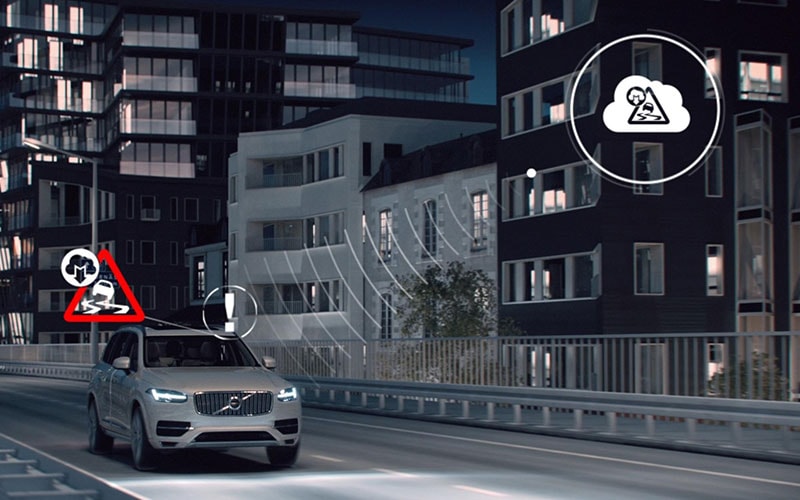
The concept is elegantly simple, but its implications are staggering. Imagine you are cresting a blind hill on a narrow two-lane road and you encounter a broken-down lorry blocking your lane. In a conventional car, your reaction time is measured in milliseconds, and your only warning is the horrifying sight of a stationary obstacle. In a modern Volvo, however, that hazard is already known to your car before you even see it. Through a sophisticated over-the-air update, Volvo is enabling its vehicles to communicate with one another in real time, sharing data about slippery road conditions, disabled vehicles, and sudden braking events. This is not a futuristic fantasy; it is the current reality for owners of the Volvo EX90 and the XC90, who are now part of a moving network that prioritizes collective awareness over individual isolation.
The Digital Sixth Sense
This system, powered by Volvo’s proprietary cloud-based infrastructure, works by utilizing the car’s advanced sensor suite—radar, cameras, and lidar—to detect hazards. When one vehicle hits a patch of black ice, its traction control system activates, and that data point is instantly anonymized and transmitted to the cloud. From there, it is pushed to other Volvo vehicles approaching the same location. The driver receives a clear, unobtrusive warning on the heads-up display and instrument cluster, allowing them to slow down well before they would have physically detected the danger. The beauty of this approach lies in its humility; it acknowledges that no single car, no matter how many sensors it carries, can see around corners or through the vehicle ahead. But a fleet of connected cars can.
The driving experience is subtly transformative. There’s a quiet confidence that comes from knowing your car has already processed a threat that your eyes haven’t registered yet. It’s not about taking control away from the driver; it’s about extending the driver’s perception. The warning is calm, informative, and immediately actionable—never a jarring alarm that induces panic. It feels less like a nanny and more like a co-pilot who has seen this road before.
More Than a Software Update
The recent news cycle has been dominated by Volvo’s technological pivots, from the arrival of Spatial Audio in CarPlay to the promise of long-range plug-in hybrids. While these features enhance the driving experience, the connected safety network represents a more fundamental evolution. It aligns perfectly with Volvo’s pledge to eliminate severe injuries and fatalities in its new cars, a goal that cannot be achieved by hardware alone. The software-defined vehicle is not just about updating the infotainment screen; it is about making the car smarter every day. This OTA update transforms the fleet into a learning organism, where a near-miss in one part of the country becomes a learning opportunity for a driver hundreds of miles away.
There’s a certain poetry here. Car enthusiasts often wax lyrical about the mechanical connection between man and machine—the feedback through the steering wheel, the response of the throttle. Volvo is adding a new layer to that connection: the awareness of the collective. It’s a different kind of driving feel, one that engages your mind as much as your hands and feet. And in a segment where performance is often measured in horsepower and lap times, Volvo is quietly benchmarking a metric that matters far more: situational awareness.
A Network Built on Trust
Critics might argue that this system relies on a critical mass of Volvo vehicles to be truly effective. They are not wrong. A network with only a few nodes is limited. However, Volvo has always understood that safety is a shared responsibility, not a competitive advantage. By implementing this system across its entire lineup, including the upcoming EX60, the company is seeding the roads with digital sentinels. The data is not used for marketing or surveillance; it is used purely for hazard mitigation, stripped of all identifying information. This trust is crucial. Volvo is asking us to accept that our cars can share data, but they are doing so with a transparency that other manufacturers often lack.
Every Volvo on the road becomes a potential guardian angel for the car behind it. It’s a philosophy that resonates deeply with the brand’s Scandinavian roots—a society built on mutual responsibility rather than individual gain. The system isn’t about making you a better driver; it’s about making everyone around you a safer driver.
The Road Ahead
As we look toward the future of mobility, the conversation often centers on autonomy—on cars that drive themselves. But the stepping stone to full autonomy is connectivity, and Volvo is already laying that pavement. The car-to-car warning system is a quiet, powerful statement that the safest car on the road is not the one with the most airbags, but the one that communicates. It is a return to the Scandinavian ethos of collective well-being, applied to the modern highway. In a world of increasing isolation, Volvo is reminding us that when we drive, we are never truly alone—and that is precisely the point. The next time you see a Volvo in your rearview mirror, know that it might just be looking out for you, too.