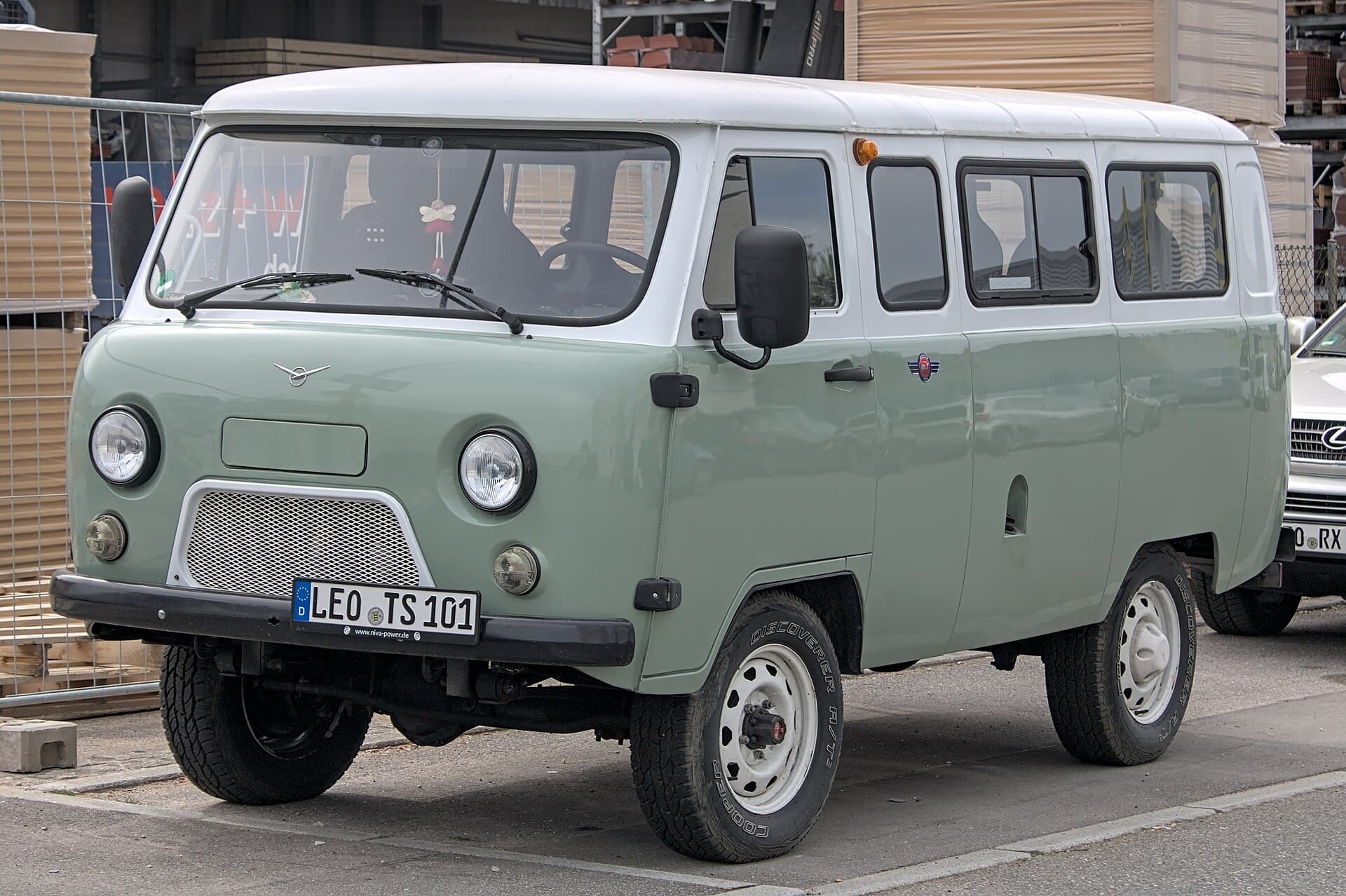
There is a particular kind of immortality that has nothing to do with sophistication. The UAZ-452—known to the world by its affectionate nickname, the Bukhanka, or "loaf"—is a vehicle that has, by any rational engineering standard, been obsolete for decades. It rides on leaf springs. It steers with a recirculating-ball setup that feels like stirring wet cement. Its engine bay houses a pushrod four-cylinder whose architectural roots predate the moon landing. And yet, in the mud tracks of the Caucasus, the frozen wastes of Siberia, and the scarred frontlines of a modern European war, the Bukhanka endures with a stubbornness that borders on the supernatural.
The secret lies in radical simplicity. Where modern off-roaders bristle with electronic terrain-management systems, the Bukhanka offers nothing but mechanical honesty. Its ladder frame is overbuilt. Its axles are rugged. Its part-time four-wheel-drive system engages with a lever, not a screen. When something breaks—and things do break—a conscript with a hammer and a length of wire can often coax it back to life. There is no diagnostic port to interrogate, no software to reflash. This is a machine designed by people who assumed the nearest dealership was a thousand kilometres away and the nearest mechanic was the driver himself. In the wildest mud tracks, as recent off-road testing has confirmed, that philosophy pays dividends no luxury SUV can match.
Mechanical Honesty Over Electronic Complexity
Strip away the romance and what remains is a design brief executed with almost brutal discipline. The Bukhanka's ladder frame is overbuilt by any modern measure, its axles rugged enough to shrug off punishment that would sideline a crossover before the trailhead. The part-time four-wheel-drive system engages with a lever, not a touchscreen menu—a tactile reminder that traction should be a decision, not a subroutine. And when something does break, the repair manual is essentially a hammer and a length of wire. There is no diagnostic port to interrogate, no software to reflash. This is a machine built by people who assumed the nearest dealership was a thousand kilometres away and the nearest mechanic was the driver himself. In the wildest mud tracks, as recent off-road testing has confirmed, that philosophy pays dividends no luxury SUV can match.
The Grim Arithmetic of Conflict
But the Bukhanka's legend was forged in fire, not merely in mud. The van's cavernous, boxy body—originally designed to haul bread—has proven endlessly adaptable to the grim arithmetic of conflict. It carries troops, ammunition, the wounded. Its flat panels accept improvised armour. Its modest dimensions slip through treelines and village lanes where larger vehicles cannot follow. This versatility explains why the UAZ appears so relentlessly in dispatches from the front, on both sides of the ledger: as a workhorse, as a target, as an ever-present fact of the battlefield. Recent reports of drones hunting UAZ vans, of border guards destroying them, of crews lost inside them, tell a double story—of the vehicle's expendability and of its indispensability. Armies keep using the Bukhanka because, quite simply, they cannot imagine waging war without it.
An Architecture That Refuses to Age
What unsettles the engineering mind is how little the machine has changed. The UAZ Patriot, the marque's modern flagship, now courts a 136 hp diesel and the trappings of contemporary comfort, yet the Bukhanka soldiers on with its ancient petrol four and its vacuum-operated wipers. Even the aftermarket has elevated the platform into something stranger and more capable: the TREKOL-39041, built on the UAZ Hunter, rides on ground clearance approaching half a metre, a rolling monument to the idea that a UAZ is merely a starting point. The marque's ambitions now stretch as far as Ethiopia, where assembly talks signal that the UAZ formula—cheap, rugged, repairable—still has markets to conquer.
The Case for Crude Genius
The Bukhanka is not a good vehicle in any conventional sense. It is slow, thirsty, crude, and punishing. But it is unstoppable in the way that matters most: it asks almost nothing of its owner and forgives almost everything. In an age of software-defined machines that brick themselves over a sensor fault, the loaf persists as a quiet rebuke—proof that durability is its own form of genius, and that the humblest tool, built honestly, can outlast empires.