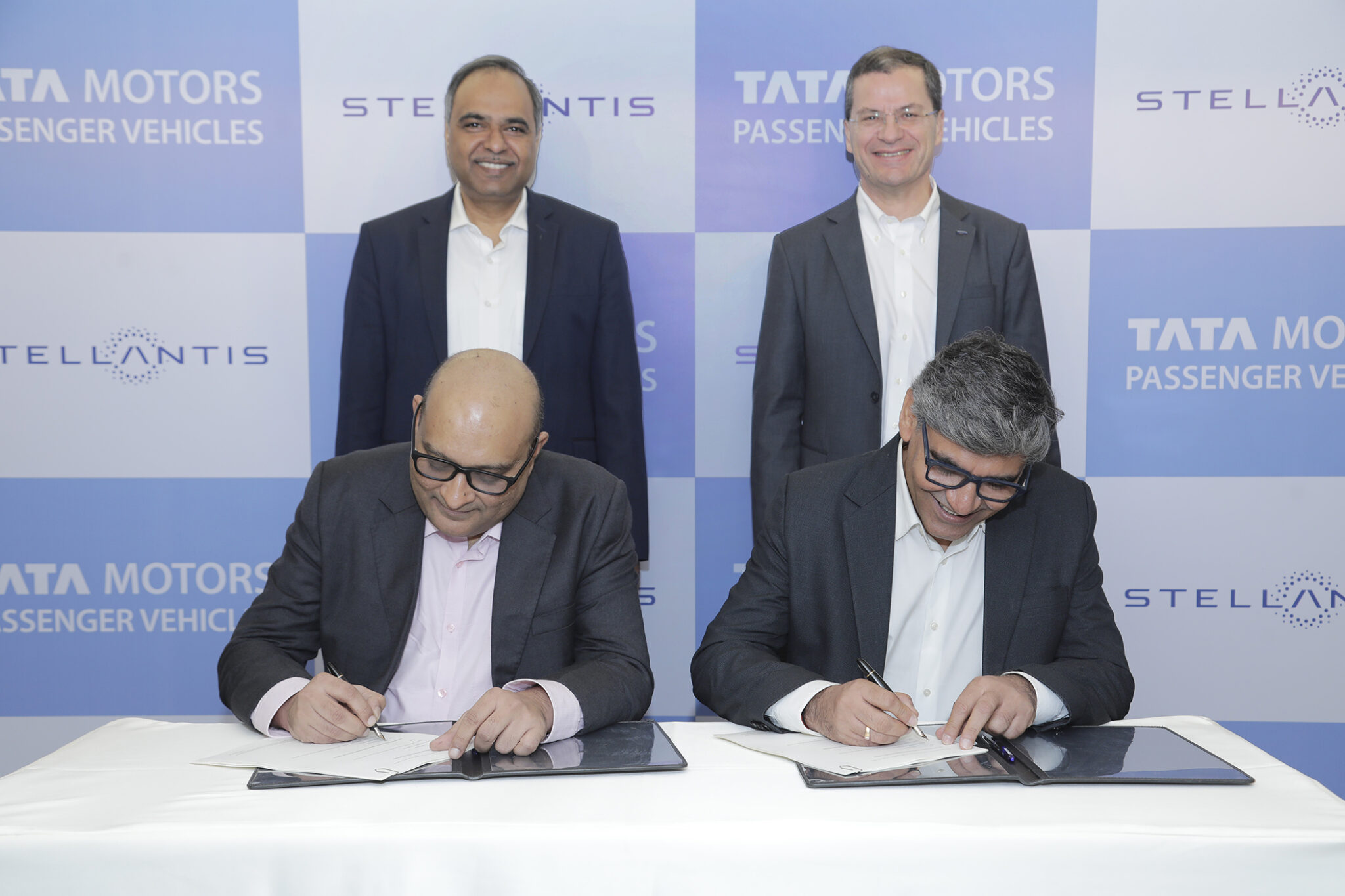
Forget the festive-season discounts and the endless facelift cycles. The most consequential story in Indian autos this year is a definitive agreement signed quietly between Tata Motors Passenger Vehicles Ltd (TMPV), its electric subsidiary Tata Passenger Electric Mobility Ltd (TPEM), and Netherlands-headquartered Stellantis — a pact that recasts India's role in the global automotive order from market to motherboard.
Under the arrangement, the two companies will jointly develop vehicles on shared platforms, engineered and built in India, for sale across more than 50 international markets. Read that again: India is no longer merely a market to be served. It is becoming the factory and the engineering brain for cars that will wear Stellantis badges from Latin America to Southeast Asia.
For decades, the global auto industry treated India as a cost-arbitrage opportunity — a place to assemble, not to originate. That hierarchy is now collapsing.
From Vendor to Co-Developer
The new agreement positions TMPV and TPEM as genuine co-developers, contributing platforms, powertrain expertise, and crucially, deep competency in cost-efficient engineering at scale. Stellantis, the sprawling house of Jeep, Citroën, Peugeot, Fiat, and Opel, brings brand reach, distribution, and regulatory access across continents. The logic is brutally simple: India builds it, the world buys it, and both partners split the upside.
This is not Tata Motors' first dance with Stellantis. The two already share a manufacturing relationship in Ranjangaon, Maharashtra, where Stellantis-produced vehicles roll off lines adjacent to Tata's own. What has changed is the ambition. Earlier arrangements were about utilising spare capacity. The new definitive agreement is about co-development — shared architecture, shared investment, shared intellectual property. That distinction matters enormously. When you co-develop a platform, you are not a vendor. You are a partner with equity in the outcome.
A Hedge Against the Margin Squeeze
The timing is instructive. Tata Motors has just reported a bruising quarter, with profit falling sharply even as revenue climbed, and management has publicly flagged uncertainty over commodity costs while signalling price hikes to protect margins. In that environment, a global partnership is not a vanity project; it is a hedge.
Spreading development costs across 50-plus markets, and amortising platform investment over volumes India alone could never deliver, is precisely how a manufacturer survives a margin squeeze without retreating from ambition. The Stellantis deal effectively converts Tata's engineering spend into an export engine.
There is a second, subtler signal here, and it concerns electric vehicles. TPEM's inclusion in the agreement is deliberate. Tata dominates India's EV passenger car market, and Stellantis has been candid about needing affordable electric platforms for emerging and mid-tier markets. An India-engineered EV architecture, validated by European safety and homologation standards, is an asset Stellantis cannot easily replicate at comparable cost. In return, Tata gains something it has never truly possessed: a frictionless route to global scale for its electric ambitions.
The Wider Game
The broader canvas makes the move look less like opportunism and more like strategy. Tata Motors is simultaneously pressing ahead with its bid for Iveco, raising its offer to €14.40 per share — a move that signals a group thinking in terms of global commercial-vehicle consolidation, not just domestic market share. Add the Stellantis passenger-vehicle pact, and a coherent picture emerges: Tata Motors is assembling the pieces of a genuinely multinational automaker, with India as its manufacturing and R&D core.
None of this is risk-free. Joint platform development demands alignment on timelines, quality benchmarks, and brand differentiation — areas where cross-cultural engineering partnerships frequently stumble. Commodity volatility and the margin pressure Tata has openly acknowledged could complicate investment cadence. And Stellantis itself is a company managing a complex multi-brand portfolio across uneven regional fortunes, which means priorities can shift.
Yet the direction of travel is unambiguous. When a European-American giant signs a definitive agreement to develop vehicles in India for 50-plus global markets, it is a verdict on Indian engineering capability, supply-chain maturity, and cost competitiveness. Tata Motors did not merely win a contract. It earned a seat at the table where the industry's future platforms are drawn — and it earned that seat on the strength of what India can build. The cars will carry many badges. The blueprint, increasingly, will be Indian.