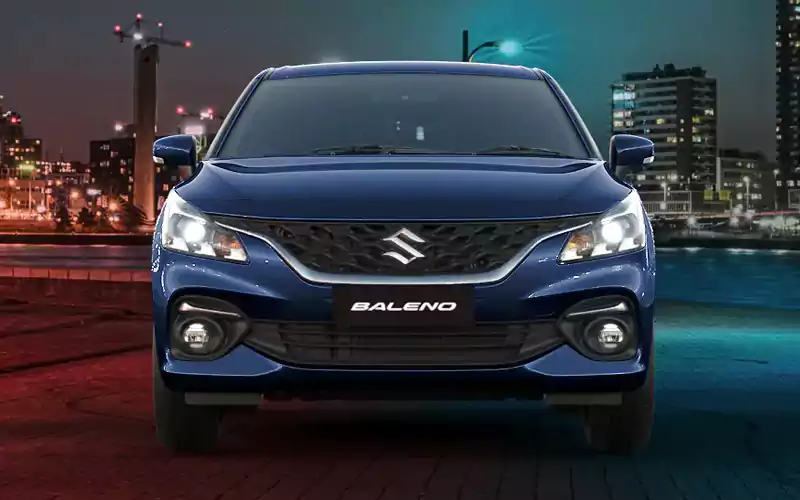
For years, the script in India’s budget car segment has been painfully predictable: if you wanted advanced driver assistance—the radar-and-camera tech that can brake for you, hold your lane, and manage speed in traffic—you needed a luxury badge and a seven-figure price tag. Safety, we were told, was a premium feature. The Maruti Suzuki Baleno facelift has just torched that narrative. Launched at ₹6.10 lakh (ex-showroom) with Level 2 ADAS as a headline feature, this isn’t a mere mid-cycle nip-and-tuck. It’s a seismic shift in what buyers can expect from a mainstream hatchback—and a gauntlet thrown down to every competitor in the fray.
Let’s get technical for a moment. Level 2 ADAS means the car can simultaneously manage steering and acceleration/braking under specific conditions, while the driver remains fully in charge. In the Baleno’s case, that translates to adaptive cruise control, autonomous emergency braking, lane departure warning, and traffic sign recognition. These aren’t spec-sheet decorations. On India’s highways—where lane discipline is often a suggestion and sudden stops are a way of life—a system that can react faster than a human foot is a genuine lifesaver. And the fact that Maruti Suzuki, the brand synonymous with frugal motoring, is democratizing this tech is nothing short of revolutionary.
The Ripple Effect on the Segment
The Baleno facelift’s real story isn’t just the hardware behind the grille; it’s the message it sends to Hyundai, Kia, Tata, and every other manufacturer playing in this sandbox. Until now, advanced safety suites have been drip-fed into the market—reserved for top trims of compact SUVs with a hefty premium attached. Maruti Suzuki, with its unrivaled dealership network and service reach, has just made Level 2 assistance accessible to buyers who might otherwise have settled for a base-spec crossover. The psychological impact is profound: if a Baleno can see and react to the road, why would a customer accept a less-equipped rival at a similar price? This is the kind of competitive pressure that forces an entire segment to raise its baseline—or get left behind.
Under the Skin: A New Powertrain and Smarter Bones
Beneath the refreshed sheet metal sits a new 1.2-litre Z-Series engine, replacing the long-serving K-Series. Output hovers around 80 bhp—modest on paper, but the new motor is tuned for low-end torque and built with an eye toward stricter emission norms. Paired with a five-speed manual or an AMT, it prioritizes urban drivability and frugality, which remains Maruti’s fortress. But don’t mistake this for a simple economy runabout.
Integrating ADAS required serious engineering muscle. A forward-facing camera and radar mounted behind the grille demand precise calibration, robust processing, and seamless integration with the braking and steering systems. That Maruti Suzuki has managed to package all of this without ballooning the price tag speaks to a supply-chain and manufacturing efficiency that few rivals can match. This isn’t a gimmick bolted on for marketing; it’s a fundamental upgrade to the car’s core architecture.
Real-World Relevance, With a Caveat
The timing is impeccable. India’s market is shifting toward safer vehicles, propelled by Bharat NCAP crash-test norms and a more informed consumer base. The Baleno facelift arrives as a direct response to that evolving consciousness. For the young urban professional seeking a modern, connected, and secure daily driver, it’s a compelling package. For the family upgrading from an older entry-level model, the presence of autonomous emergency braking could be the deciding factor—choosing a smaller car that can protect you over a larger one that can’t.
Of course, there’s a caveat. Level 2 ADAS is not autonomy. Indian roads throw curveballs—stray cattle, two-wheelers filtering through traffic, faded lane markings—that can confound even the most sophisticated sensors. The system performs best on well-marked highways and predictable traffic flow. Maruti’s dealer training and owner education will be crucial in setting expectations. But this is a mature, responsible approach. The Baleno facelift isn’t promising a self-driving future; it’s offering a safety net.
A New Benchmark for the Masses
In a country where road fatalities remain alarmingly high, the availability of such a net in a mainstream, affordable package is a development that deserves attention far beyond the showroom floor. The Baleno facelift doesn’t shout about its safety credentials; it embeds them into the car’s standard operating procedure. And in doing so, it rewrites the rulebook for what a budget hatchback can—and should—be.
This is Maruti Suzuki at its most audacious: not just building cars for the masses, but redefining what the masses deserve. The Baleno has always been a smart choice. Now, it’s a smarter one—in every sense of the word.


