Some brands chase the spotlight. Others quietly sell cars to people who actually need them. Soueast belongs firmly in the second camp, and for most of its existence, that has been entirely the point.
Born in 1995 as a joint venture between Fujian Motor Industry Group and Taiwan's China Motor Corporation, Soueast spent its formative years assembling Mitsubishi-derived models — the Lioncel, the V3 Lingyue, the DX7 — for buyers who wanted Japanese mechanicals without Japanese pricing. When the Mitsubishi partnership wound down in the late 2010s, Soueast was left with a factory, a dealer network, and a question that has sunk prouder marques: what is a brand without its engineering benefactor?
The Customer Nobody Else Wanted
The answer, it turns out, was hiding in plain sight in the showrooms of Fujian, Jiangxi, and Anhui. While China's tier-one cities — Shanghai, Beijing, Shenzhen — chased premium EVs and NIO clubhouses, the tier-two and tier-three markets kept buying conventional three-box sedans. Not glamorous ones. Practical ones. Cars priced between 80,000 and 130,000 yuan, financed over five years, serviced at dealerships that still smell of new carpet and instant coffee.
Soueast, with its provincial roots and its network of 300-plus outlets concentrated in exactly those cities, was better positioned to serve that customer than any startup burning venture capital on flagship stores in Sanlitun. That is not a romantic position to occupy. It is, however, a commercially intelligent one.
The Sedan as a Rearguard Action
What followed was a deliberate rearguard action built around the sedan. The Soueast A5 Yiwu — a compact four-door launched in 2021 — became the template: a 1.5-litre turbocharged engine, a continuously variable transmission tuned for smoothness rather than sport, and a cabin that borrowed its 10.25-inch touchscreen interface from the same supplier ecosystem that serves Geely and Changan.
It was not a car that would trouble a magazine cover. It was a car that would trouble a spreadsheet, and in the second-tier city dealerships, that is the only review that matters. The A5 Yiwu understood something the industry's premium obsessives keep forgetting: for a vast swathe of Chinese buyers, a sedan is not a statement. It is transport, and transport has to make financial sense.
Raising the Ceiling Without Losing the Plot
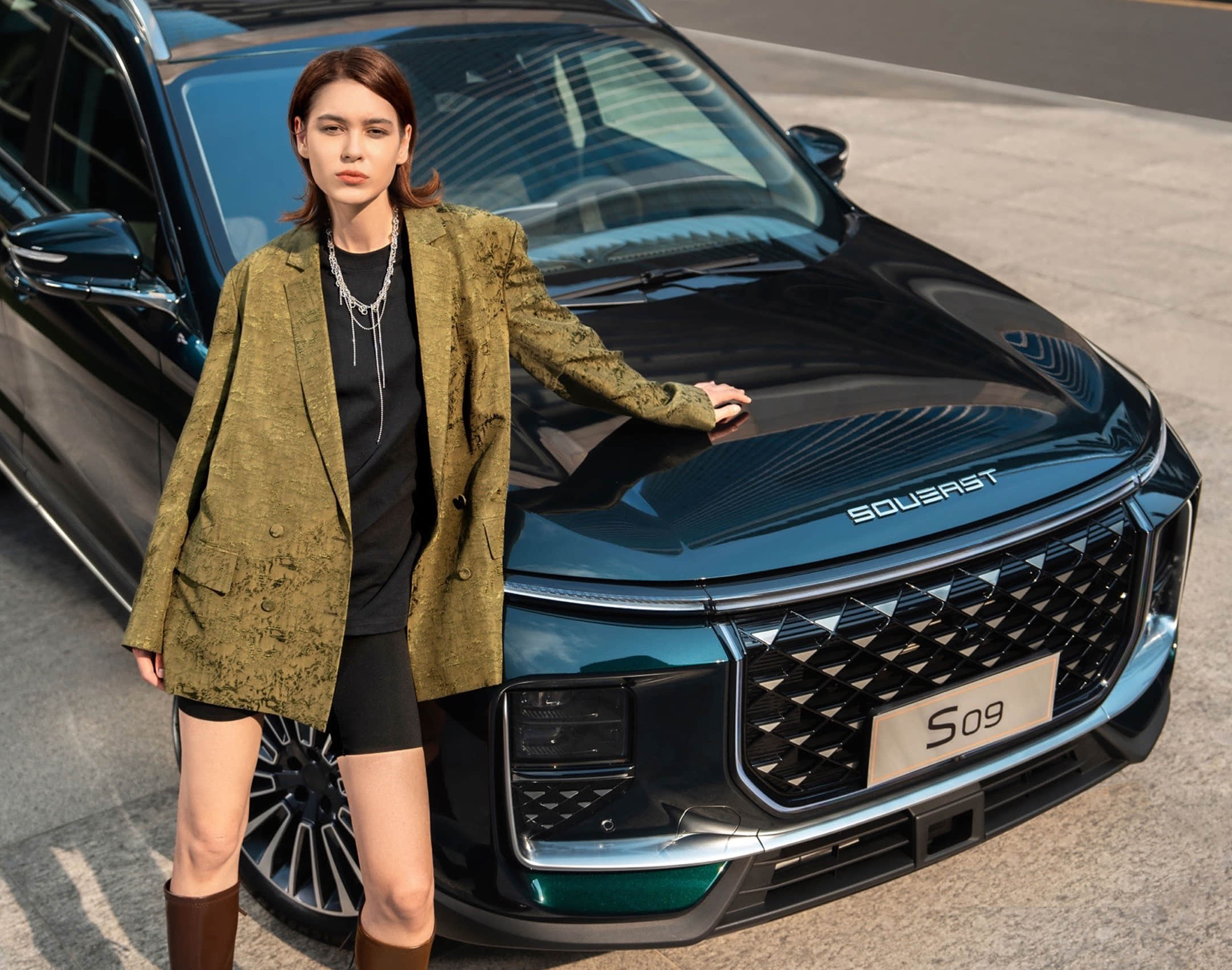
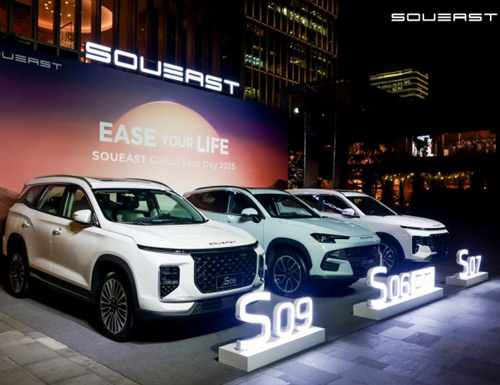
The strategy tightened with the Soueast DX5 refresh and, more importantly, the Soueast S09, a larger sedan that pushed the brand's ceiling toward 150,000 yuan without abandoning the value proposition. Soueast's engineers, now working under the umbrella of Fujian's provincial industrial planners and a deepening technical relationship with Chery, leaned into a simple promise: Japanese-adjacent build quality at domestic pricing, with a warranty that stretched to five years or 150,000 kilometres.
In markets where a car is a family asset rather than a personal statement, that warranty is a marketing campaign in itself. It speaks to a buyer who plans to keep the car for a decade, not a lease cycle. It says: we will still be here when you need us. For a brand rebuilding its identity after the Mitsubishi divorce, that is a powerful thing to say.
The Discipline of Saying No
The results have been quietly instructive. Soueast's annual volumes, which had slumped below 30,000 units during the Mitsubishi divorce, recovered into six figures by the mid-2020s, with the sedan line accounting for the plurality of sales. The brand's Fuzhou manufacturing base, expanded and retooled, now runs shifts that would have seemed fanciful a decade ago.
And crucially, Soueast has resisted the temptation that has derailed so many mid-tier Chinese automakers: it has not launched a vanity EV sub-brand, nor has it chased the premium segment with a car its dealers cannot explain to their customers. That restraint is rarer than any powertrain innovation, and in an industry drunk on disruption, it looks almost radical.
There is a lesson here that the industry's louder voices keep missing. The Chinese auto market is not a single market. It is a stack of them, and the bottom two-thirds are still buying sedans with petrol engines and conventional financing. Soueast's revival is not a triumph of technology or design. It is a triumph of geography and discipline — of knowing which cities you serve, which customers you serve, and refusing to be embarrassed by either. In an era when every brand wants to be a lifestyle, Soueast has settled for being a car company. In Fuzhou, Nanchang, and Hefei, that is currently enough.