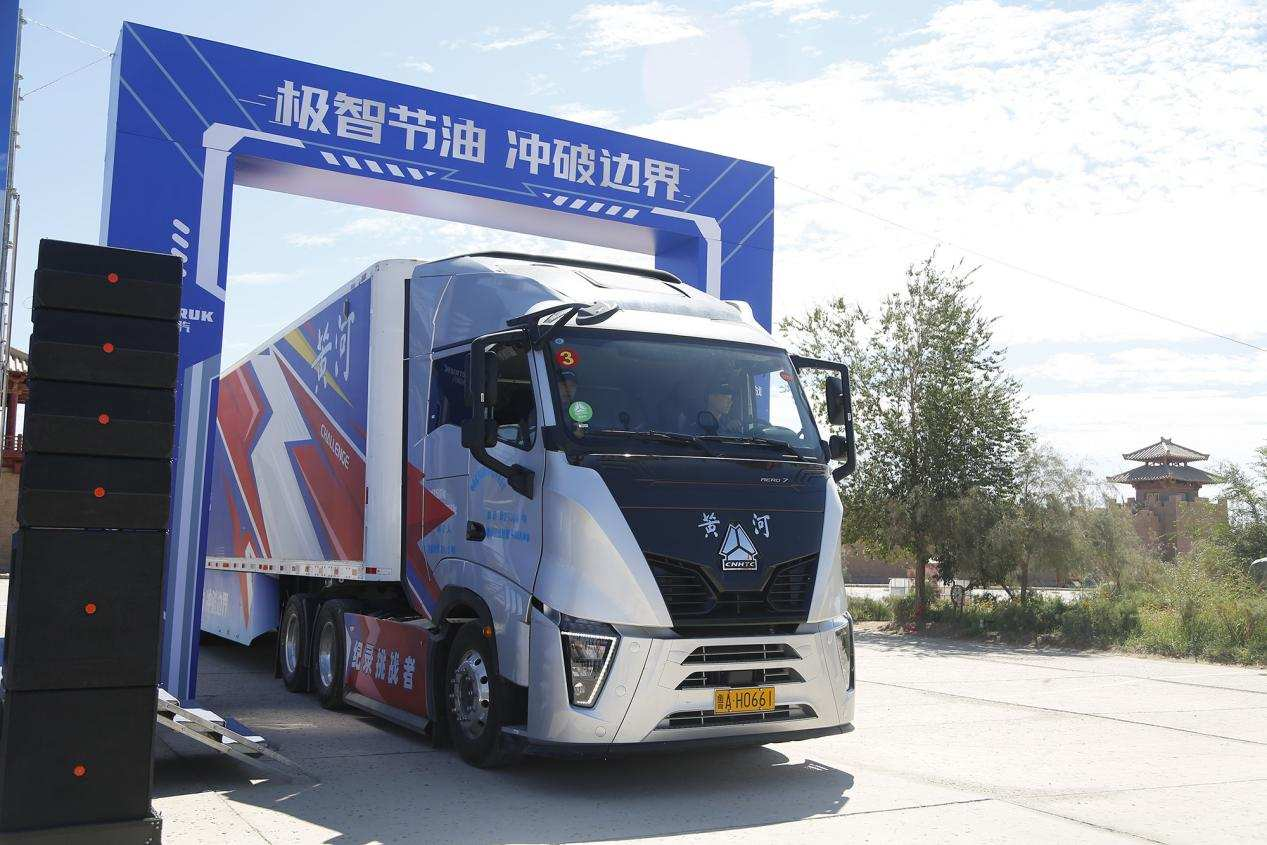
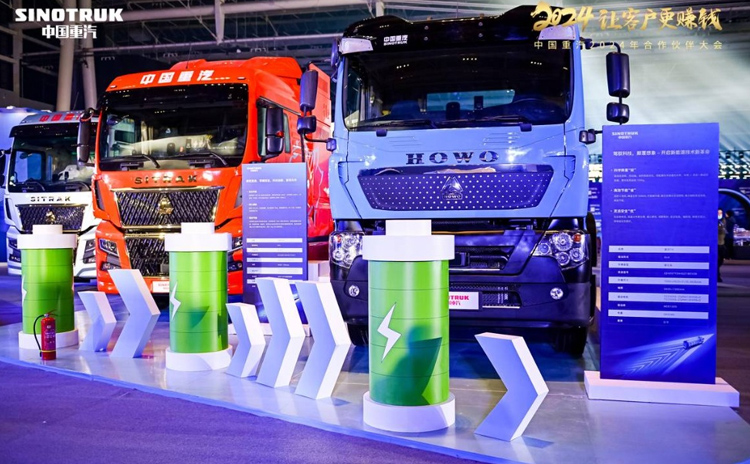
Every electrification pitch eventually collides with a haul road. Sinotruk has spent two years building a persuasive arithmetic around its new-energy heavy truck line, and the headline number — repeated across investor decks and trade-show stages — is that each electric heavy truck saves roughly ¥200,000 per year in fuel costs compared with a diesel equivalent. It is a figure that has travelled well, and it has done real work: it helped the company post a sharp rise in revenue and net profit on robust heavy-duty truck sales, it underpins a proposed interim cash dividend from Sinotruk Ji'Nan Truck, and it earned the group a Buy rating from Daiwa.
It is also, in the specific conditions where a great many Sinotruk trucks actually work, close to meaningless. That is not a knock on the hardware. It is a lesson in what happens when a highway number is asked to survive a gravel pit.
The Highway Assumption
The ¥200,000 figure is a highway number. It assumes high annual mileage, predictable duty cycles, depot-based charging at industrial electricity rates, and a vehicle that spends its life at steady load on paved roads. That is a coherent operating model, and for fleets that match it, the arithmetic can hold.
Quarry work, construction haulage, and mining support — the segments where Sinotruk's rugged conventional tractors have historically earned their reputation — invert nearly every one of those assumptions. Off-road duty cycles are short, brutal, and unpredictable. A truck may run loaded for four kilometres and return empty, repeatedly, at gradients and surface conditions that push energy consumption far above any highway benchmark. The fuel savings that look so compelling on a spreadsheet shrink materially once consumption per kilometre rises and daily distance falls.
Charging Is the Harder Problem
A 400-plus kWh battery pack is a substantial asset that must be replenished between shifts, and off-road sites rarely offer the kind of grid capacity such packs demand. Operators in remote quarries frequently run on diesel gensets, which reintroduces the very fuel cost the pitch claims to eliminate — at a worse conversion efficiency than simply burning diesel in the engine. Where grid power exists, it is often weak and expensive to upgrade.
The infrastructure cost does not appear in the ¥200,000 line, but it lands on the operator's balance sheet regardless, and it is frequently larger than the annual saving being promised. That is the quiet flaw in the headline: it prices the truck, not the system around it.
The Payload Penalty
Battery mass is not free. In jurisdictions where gross vehicle weight is enforced at the pit gate, every kilogram of cells is a kilogram of aggregate that cannot be sold. Operators running weight-sensitive haulage must either accept reduced payload per trip or add trips, and both erode the economics.
Off-road, the trade-off is sharper still, because the routes are shorter and the payload penalty is spread over fewer revenue kilometres. The truck carries its fuel bill in its chassis whether the day goes well or badly.
Selling the System, Not the Sticker
Sinotruk is not standing still on this. The company's expansion into Europe via Steyr Automotive — assembling both electric and diesel trucks — and its integrated energy-solutions showcase at IAA Transportation 2026 signal a genuine strategic push beyond hardware into charging and energy management. That is the correct direction, and it acknowledges implicitly that the truck alone is not the product.
But Europe's established manufacturers are making the same move with deeper service networks, and the Chinese arrival at European truck shows has been widely framed as a competitive threat precisely because the hardware is credible. Credibility in a show hall is not the same as viability in a gravel pit.
There is a further complication in the margin story. Sinotruk's recent results show revenue and net profit rising sharply on robust heavy-duty sales, but gross margin narrowing. Aggressive electrification pitches are part of how volume gets defended, and the ¥200,000 claim is a marketing instrument as much as an engineering estimate. It works best on buyers whose operations resemble the model behind it: high-mileage, depot-charged, highway-dominated fleets. For those customers, the number may well hold. For a quarry operator in a remote province, running two shifts on poor roads with no meaningful grid connection, the calculation is entirely different — and the truck that makes sense is still the diesel one.
None of this makes Sinotruk's electrification strategy wrong. It makes the universal framing of the ¥200k pitch wrong. Fuel savings are a function of duty cycle, energy price, infrastructure, and payload — four variables that off-road operations push in the least favourable direction simultaneously. Sinotruk's export ambitions to 2030 and its European assembly plans will be judged on whether it can sell the whole system, not the sticker figure. Until then, the headline belongs on the motorway, not in the pit.