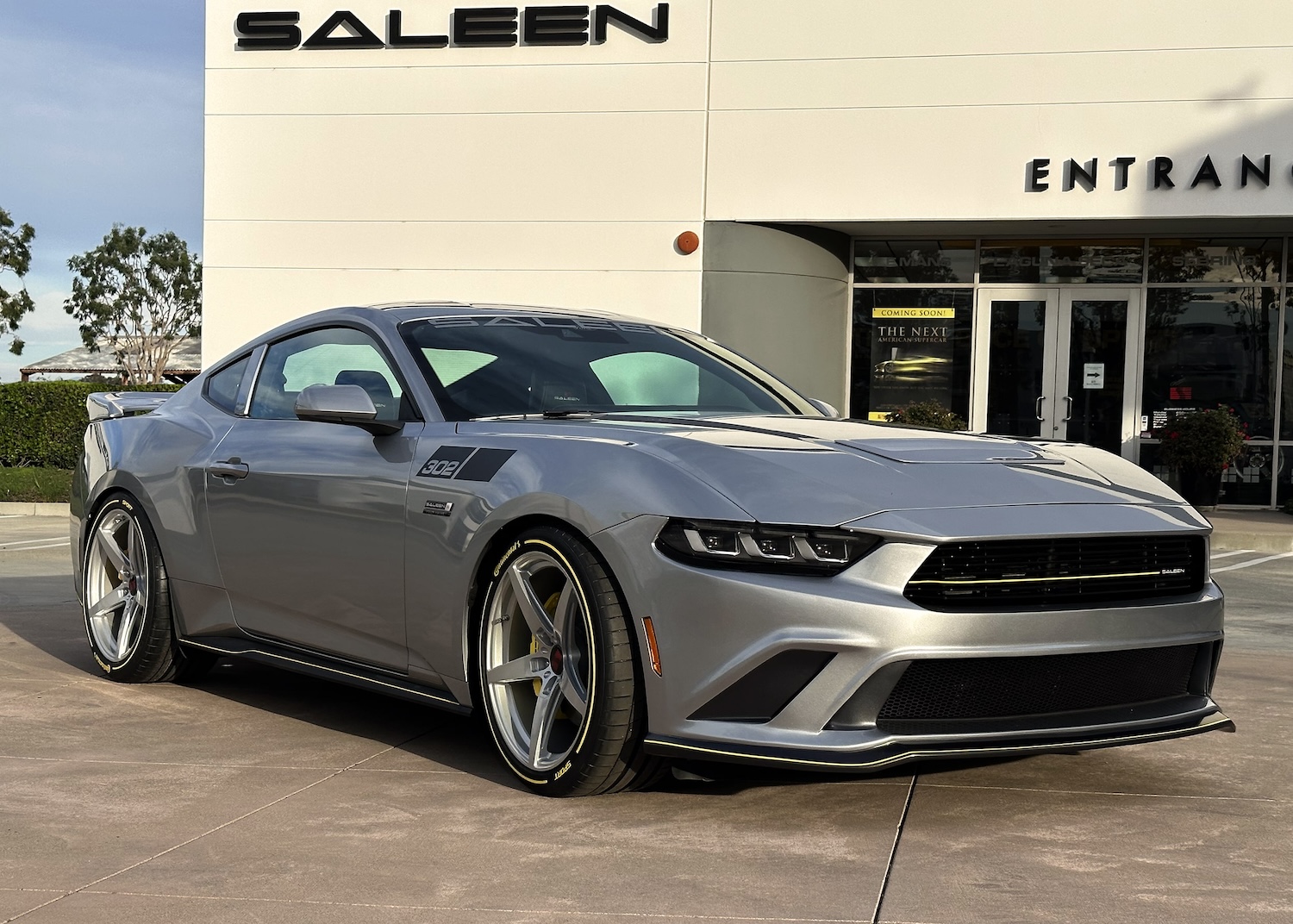
Here is a curious thing about the automotive press: it will dutifully report the arrival of a long-delayed supercar for weeks on end, then almost entirely miss the smaller, stranger story sitting right beside it. So it has gone with Saleen. The headlines have been dominated by the news that the S1 — the company's mid-engine sports car — is finally, at long last, available to order, roughly eight years after it was first revealed to the world. That the order books are opening nearly a decade after the debut is not so much a launch as an exhumation.
But that is not the most important thing happening at Saleen right now. That distinction belongs to a widebody Mustang — a halo car that Steve Saleen's company intends to build only if enthusiasts will fund it, with shares available at roughly $500 apiece through a crowdfunding campaign. On paper, this is the smaller story: a tuner teasing a modified pony car, hat in hand, asking the faithful to underwrite the project. In practice, it is the only story at Saleen that carries genuine strategic weight.
The S1 Problem
Consider the S1 honestly. A mid-engine sports car bearing the Saleen badge was always a fascinating ambition — a boutique American answer to European exotica — but the market has moved decisively against it. The 450-horsepower machine now commands Corvette Z06 money, some $47,000 more than a Lotus Emira. At a price that undercuts nothing and outflanks the C8 Corvette by a margin no rational buyer can ignore, the S1 asks customers to bet nearly six figures on a company whose follow-through has been, to put it gently, erratic.
The car may well be excellent. It scarcely matters. The S1 is a decade-old promise arriving in a market that has already been rewritten twice over, and no amount of horsepower can undo that. It is a cautionary tale more than a contender.
Returning to the Bloodstream
The crowdfunded Mustang, by contrast, is Saleen doing the thing Saleen has always done best: taking Ford's most beloved platform and making it feral. The company's legacy was built on cars like the S281, whose 2004 example with barely 9,000 miles recently surfaced for sale — a reminder of the era when a Saleen badge on a Mustang meant something immediate and visceral. The ultra-rare Saleen Terminator still commands the kind of reverence that prompts comparisons to Ford's own Mustang GTD, and that is no small compliment. This is the bloodstream of the brand. A widebody halo Mustang feeds directly into it.
The Referendum Built Into the Price
There is also a philosophical argument buried in the financing strategy. Asking the community to buy shares is not merely a fundraising tactic; it is a referendum. If enough enthusiasts put up $500 to back a wild Mustang, Saleen learns precisely what its audience wants and earns a built-in constituency invested in the car's success. That is a far more honest transaction than quietly opening order books on a supercar nobody asked to wait nine years for. Crowdfunding a Mustang is a brand saying: we know who we are, and we know who you are. It is the opposite of the S1's top-down, perpetually deferred promise.
The Direction of Travel
None of this guarantees the halo car will be built, and Saleen's history counsels skepticism about any announcement bearing its name. But the direction of travel matters. A company that returns to its core — the Mustang, the widebody, the accessible American performance icon — is a company with a future. A company that keeps insisting on a mid-engine supercar it cannot deliver is a company living in a past it never quite reached.
The S1 will generate headlines, and rightly so; it is a curiosity, a what-if made metal at last. But the $500 crowdfunded Mustang is the car that tells us whether Saleen intends to remain Saleen. Bet on the pony car. It is the only bet the company can still win.