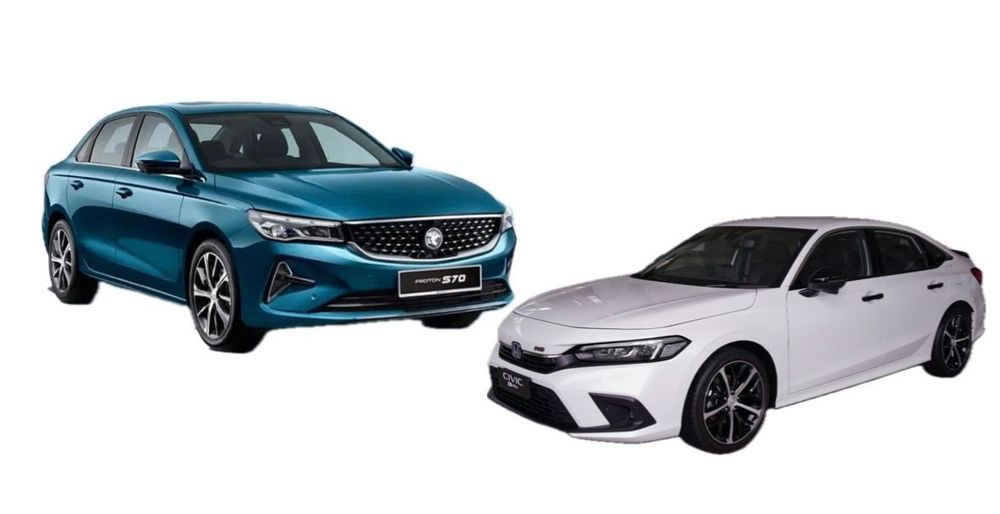
For decades, the Malaysian C-segment sedan market has run on a predictable hierarchy. The Honda Civic sits at the top, its badge carrying a premium that buyers have long accepted as the natural order of things. Then the Proton S70 arrived, and suddenly that order looks less like gravity and more like habit. This is not the traditional value play—the cheaper alternative that asks you to swallow a list of compromises. The S70 is a calculated strike at the heart of the C-segment formula, one that leans on Proton's access to parent company Geely's engineering resources to compete on merit rather than price alone.
That shift matters because it changes the nature of the comparison. The S70 doesn't ask to be judged against a lower standard; it invites a straight spec-sheet duel with the Civic—and it has the hardware to make that duel genuinely interesting.
The Price Argument, Backed by Substance
The most immediate point of differentiation is cost. The Proton S70 undercuts the Honda Civic by a margin that's difficult to ignore, particularly with the specification sheets laid side by side. Where the Civic commands a premium reflecting its established reputation and strong resale value, the S70 arrives with a feature set that would look generous even a segment above its own.
The top-tier Flagship variant bundles a comprehensive ADAS suite, a large central touchscreen, and a digital instrument cluster—equipment that typically requires stepping into higher trim levels or paying significantly more from Japanese competitors. Crucially, this isn't a budget car dressed up with superficial trinkets. The S70's technological arsenal is substantive, and it's genuinely useful in daily operation.
Built on Geely's BMA Platform
Underpinning the S70 is the Geely BMA platform, a modular architecture already proven across multiple models within the Geely ecosystem. This shared foundation is perhaps Proton's most significant strategic advantage: it lets the Malaysian manufacturer benefit from its Chinese parent's research and development resources without diluting the brand's local identity.
The result is a sedan that feels notably more sophisticated than its price point suggests, with a chassis exhibiting a composure and refinement that would have seemed implausible from a Proton product just a decade ago. The 1.5-litre turbocharged engine delivers adequate performance for the class—though enthusiasts will note that the Civic's powertrain remains the more engaging option for those who prioritise driving dynamics.
A Cabin That Makes the Case
Interior execution is where the S70 makes its most compelling argument. The cabin design is modern and uncluttered, with materials quality that belies the asking price. Connectivity features—including smartphone mirroring and voice command functionality—are integrated with a fluency that suggests Proton has learned valuable lessons from its Geely partnership.
The Honda Civic, for all its virtues, has at times been criticised for interior materials that feel less premium than its price implies. In this respect, the S70 narrows the gap considerably, offering a cabin environment that feels genuinely competitive rather than merely adequate.
What the Civic Still Owns
None of this dismisses the Civic's advantages. Its resale value remains among the strongest in the segment, a factor that significantly affects total cost of ownership over time. Its dealer network is extensive and well-established, and the brand's reliability reputation is backed by decades of consistent performance. For buyers who prioritise long-term peace of mind and the security of a familiar badge, the Civic's premium may well be justified.
Proton, meanwhile, keeps building its own case—and the S70 represents a meaningful step in that evolution.
Whether the Proton S70 can outclass the Honda Civic on value is ultimately a question each buyer must answer according to their own priorities. What's beyond dispute is that the S70 has made the comparison genuinely interesting, forcing the Civic to justify its premium in ways previous challengers rarely achieved. For a brand once associated with entry-level transportation, that signals an ambition both refreshing and, on the evidence, entirely credible.