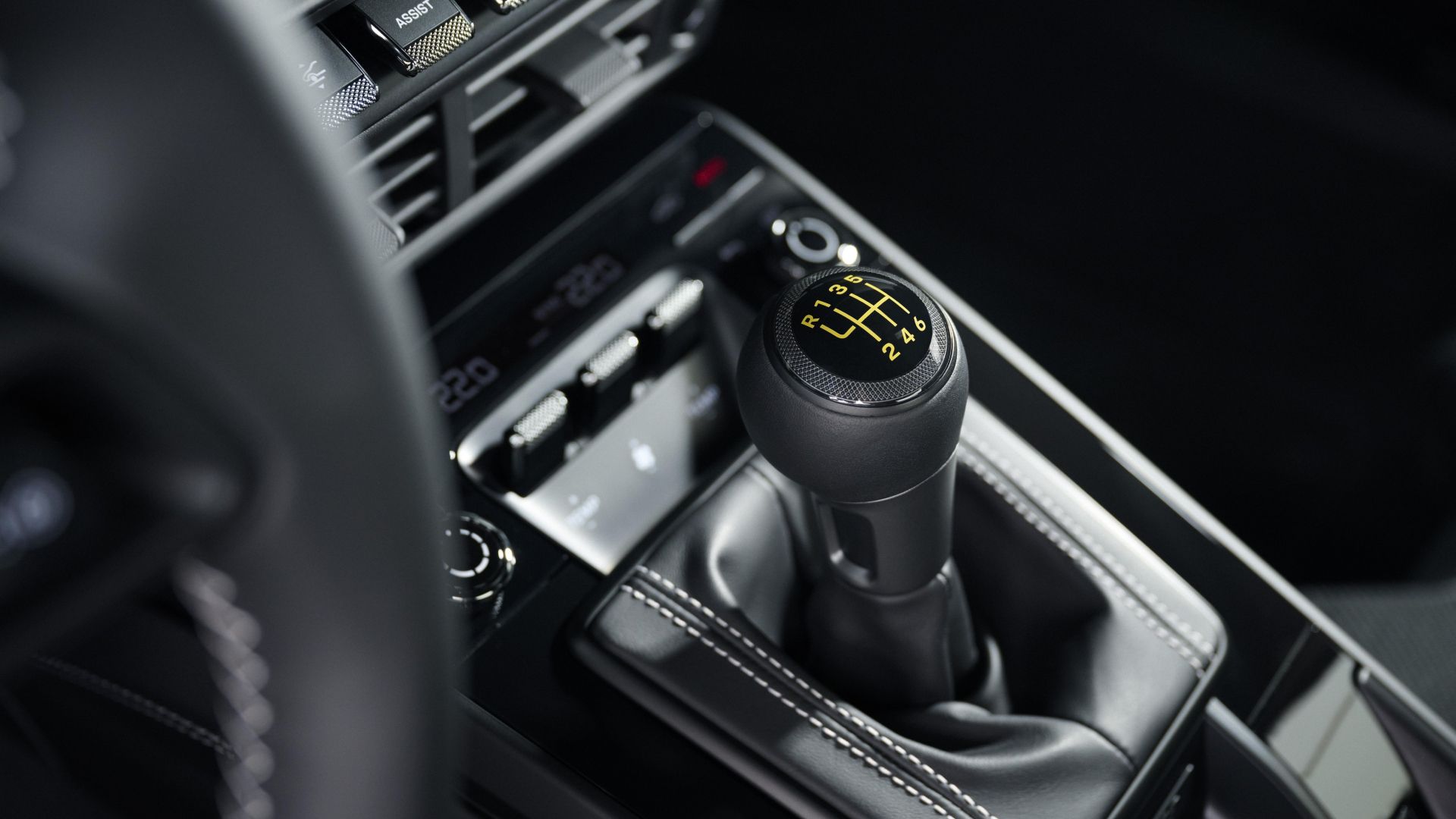
Porsche has filed patents for a dual-clutch transmission with a real clutch pedal and an H-pattern shifter, and the internet has already decided how to feel about it. The reflexive verdict writes itself: engineering theater, a simulation of engagement for people who want the aesthetic of driving without its consequences.
But that verdict is lazy, and it misreads both the technology and the moment. What Porsche is proposing isn't fake. It's a translation — and it may be the last genuinely interesting thing happening to the driver's car.
The Mechanics Kill the Cynicism
Start with the hardware, because the skepticism usually collapses there. A conventional manual demands that the driver manage a friction point, match revs, and accept that a missed shift is a real event with real consequences. A dual-clutch gearbox with a clutch pedal and a gate is not that. The pedal is a switch, the shifter is a request, and software arbitrates.
Purists will call this a costume. They are correct, and it doesn't matter — because the alternative on the table is not a manual. The alternative is a paddle. Porsche isn't choosing between a real manual and a fake one. It's choosing between a fake one and nothing at all, and there is a meaningful difference between a car that invites your hands and feet into the process and one that reduces you to a thumb.
A Brand Being Repriced by Analysts
The context makes this sharper. Porsche is reportedly cutting production toward 200,000 units while developing a supercar said to cost around $574,000, and its standing inside Volkswagen has shifted from crown jewel to line item. Reuters has framed the brand's decline as a problem for its parent; Motor1 has run the numbers and argued that Skoda is now the group's real value story.
When a marque is being repriced by analysts, the temptation is to chase volume and homogeneity. Instead, Porsche is patenting a mechanism whose only purpose is to make a hybrid powertrain feel like an event. That is not the behavior of a company that has given up on drivers. It is the behavior of one that knows exactly who still pays a premium.
A Prosthetic That Preserves the Ritual
The manual is dying not because enthusiasts stopped wanting it, but because electrification and hybridization make the traditional three-pedal layout genuinely difficult to engineer around. Ferrari already went down this road with its own dual-clutch "manual," and Autoblog is right that Porsche is following.
The honest framing isn't "Porsche fakes a manual." It's "Porsche admits the manual can't survive unassisted and builds a prosthetic that preserves the ritual." Ritual, it turns out, is most of what we mean when we talk about a driver's car. Nobody needs a gated shifter to move cargo. The gate exists because the act of moving it feels like something.
The Gravity Comes From the Periphery
There's a broader signal here too. The same company is reportedly exploring a flat-eight supercar, a shop in Germany is hand-building ten 944 wagons Porsche never made, and owners are lifting 911 Dakars and driving fifteen-year-old Cayennes across ten thousand miles without drama.
This is a brand whose gravity comes from the periphery — the weird, the analog, the obsessive. A dual-clutch with a clutch pedal belongs to that lineage far more than another crossover does. It's a bespoke answer to a question the market stopped asking: what if the machine respected your hands?
So no, it isn't real. It's better than real in the only way that matters — it keeps the conversation, and the left foot, alive for another generation of cars that would otherwise have nothing to say to a driver at all. Porsche could have quietly let the manual die and blamed the regulations. Instead it's building a ghost with a clutch pedal. That's not theater. That's grief, handled with engineering.