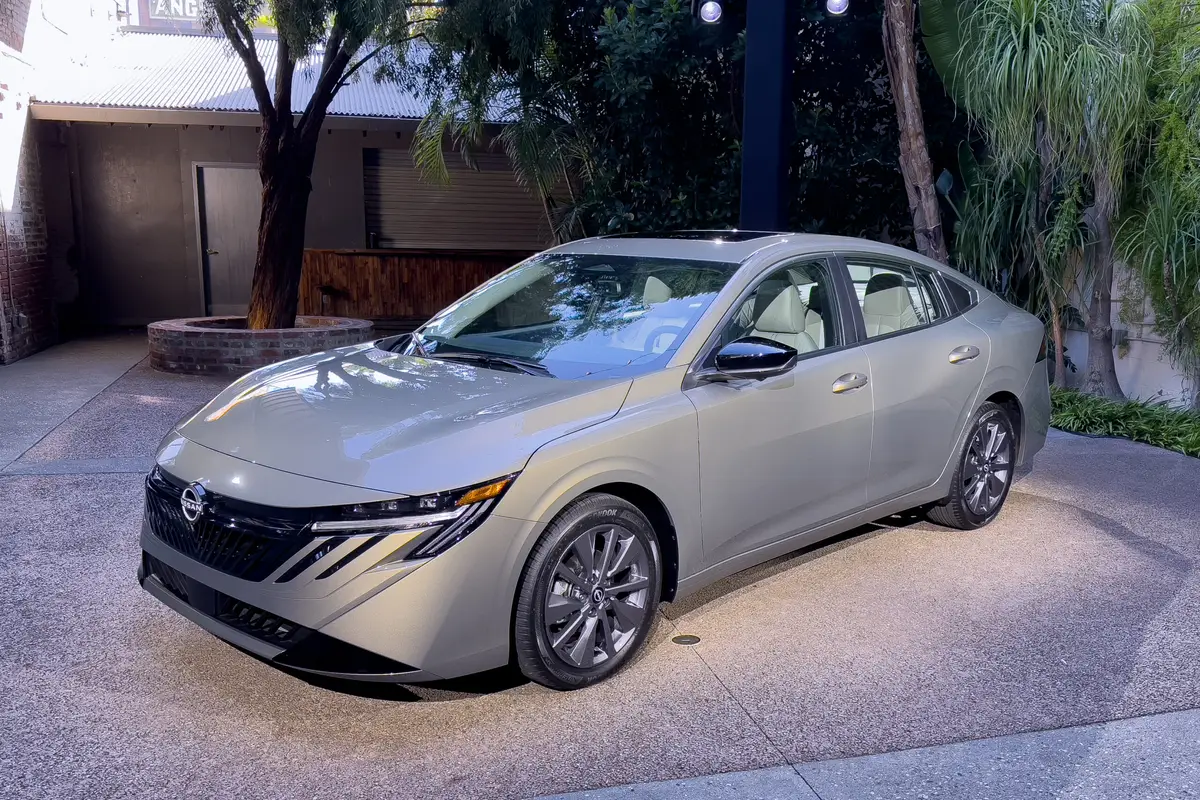
Every year, the SEMA Show rolls into Las Vegas with a parade of wildly overbuilt show cars—carbon-fiber fantasies and six-figure builds that exist only to fill booth space and Instagram feeds. Most are forgotten by the time the Convention Center empties. But every so often, a concept cuts through the noise because it speaks to something real, something the industry has spent two decades trying to convince us was extinct. This year, that concept is Nissan's Sentra Spec-V—a 300-horsepower, six-speed-manual compact sedan that feels less like a marketing exercise and more like a dare.
The details matter here. Nissan took its humble Sentra—a car best known for rental fleets and sensible commuting—and dropped in a powertrain good for roughly 300 horsepower, paired exclusively with a six-speed manual transmission. It wrapped the package in NISMO hardware, gave it the SE-R and Spec-V badging that once defined the affordable-performance golden age, and rolled it onto the show floor. The message was unmistakable: cheap speed is not dead. It has simply been waiting for someone to build it again.
The Catch That Makes It Matter
There is, of course, a catch—the one every outlet reporting on the concept has flagged. As a SEMA concept, the Sentra Spec-V carries no production commitment. It is a design study, a conversation starter, a test balloon. But that is precisely why it matters. SEMA concepts are how automakers read the room. When a brand invests the engineering hours to build a running, manual-transmission, 300-hp compact and then watches the enthusiast press lose its collective mind, that data lands in product-planning meetings. The Sentra Spec-V is not a promise. It is a question posed to the market—and the answer, judging by the reception, is a resounding yes.
A House of Contrasts
The timing is not accidental. Nissan's current portfolio is a study in contrasts. The company is pouring resources into the 2027 Rogue Hybrid, a genuinely impressive piece of engineering that will serve as its first software-defined vehicle as it chases Tesla and Chinese rivals. The Rogue is the future—efficient, connected, and utterly rational. Meanwhile, Nissan employees quietly built a race-ready Z with a throwback livery, and the brand gave the original Z a twin-turbo V6 and carbon-fiber makeover. There is a bonkers 500-hp Pathfinder headed to SEMA as well. Read together, these projects reveal a company trying to reclaim something it once owned: the reputation for building cars that enthusiasts actually want to drive.
Heritage as a Blueprint
That reputation was built on exactly this formula. The original Sentra SE-R of the early 1990s was a giant-killer—light, revvy, and cheap enough that young drivers could actually afford one. The later Spec-V carried that torch with a 2.5-liter four and a limited-slip differential. These were not halo cars. They were entry points, the machines that turned teenagers into lifelong brand loyalists. Somewhere along the way, the industry decided that segment was unprofitable and let it wither. The result is a generation of enthusiasts priced out of the hobby and a market segment—the affordable performance compact—that sits virtually empty.
Nissan is not alone in sensing the vacuum. But it is one of the few brands with the heritage to fill it credibly. The Sentra Spec-V concept works because it is not nostalgia for its own sake; it is a blueprint. A 300-hp compact sedan with a manual gearbox and NISMO tuning, priced within reach of a working enthusiast, would have almost no direct competition. The business case writes itself—provided the company has the nerve to build it.
The Real Test
That is the real test. Concepts are cheap; commitments are expensive. But the enthusiasm swirling around this one suggests the demand is genuine and the appetite is real. Nissan has spent years being praised for competent, sensible products like the Rogue and the Frontier Pro-4X. What the Sentra Spec-V offers is something rarer: a reason to be passionate about the badge again. If Nissan reads the room correctly, the cheap-speed renaissance could start right here—in the most unlikely nameplate of all.