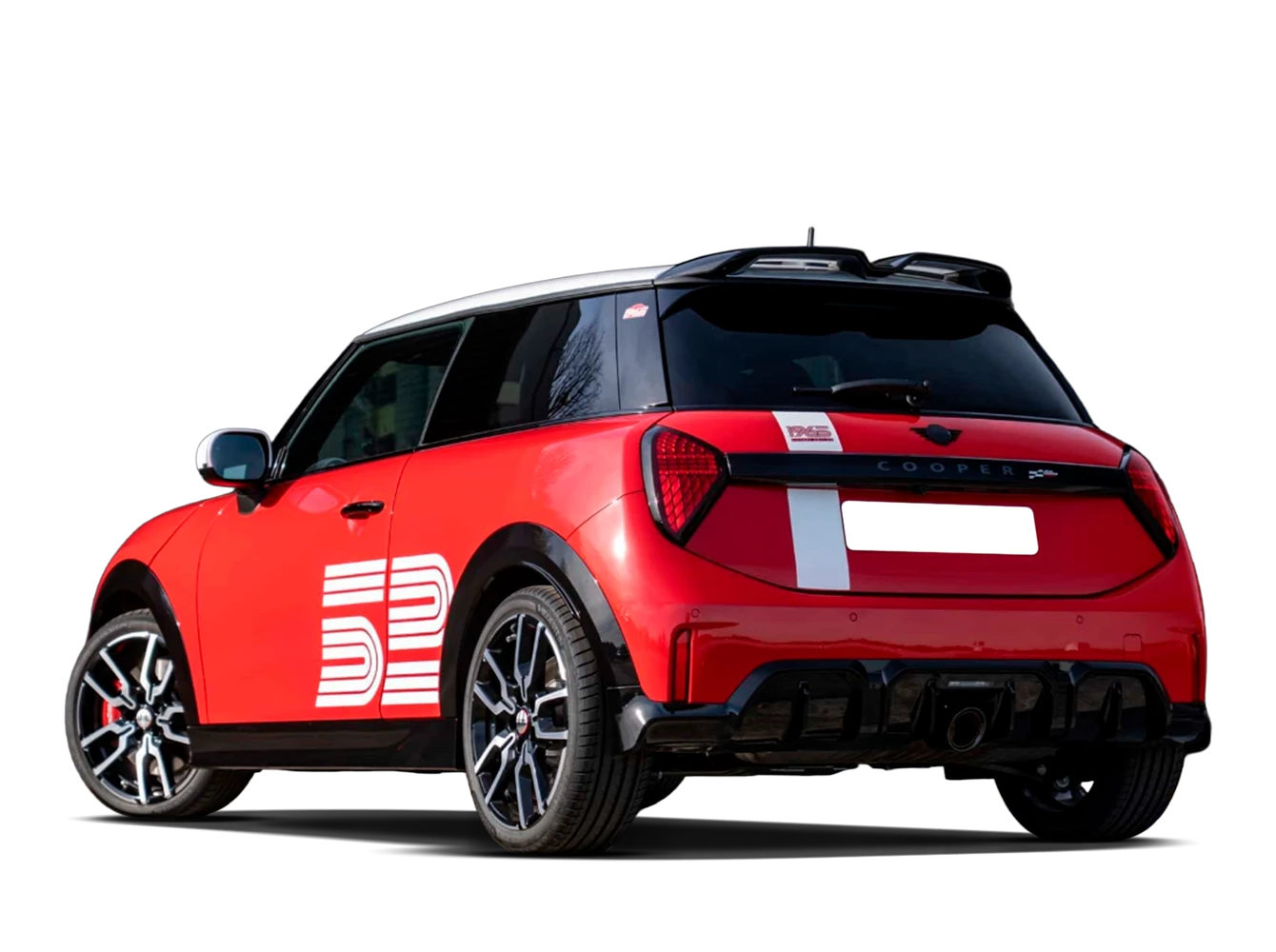
The hot hatch has spent twenty years sprinting headlong into a horsepower arms race, every new generation arriving with more boost, more output, and more aggressive bodywork than the last. So when Mini announced the 2027 Mini 1998 GT — a car that deliberately stops short of the John Cooper Works power ceiling — the reaction split neatly in two. Quiet confidence to some. Outright heresy to the forums. As ever with Mini, the truth is more interesting than either camp allows.
The 1998 GT takes its name from the year the modern Mini project began taking shape under BMW's stewardship, and its positioning is unmistakably nostalgic. It borrows the chassis poise and suspension tuning that have made the current JCW one of the sharpest front-drive cars on sale, then dials the engine back a notch. Car and Driver's early assessment caught the paradox neatly: JCW moves, without the same power. For purists who remember when the original Cooper S made do with barely over 160 horsepower and still embarrassed far more expensive machinery on a back road, that arithmetic isn't a compromise. It's a return to first principles.
The Grand Sport Analogy
There's a pointed comparison circulating in the enthusiast press that frames the 1998 GT as the Corvette Grand Sport of hot hatches — a car that trades outright output for chassis balance, sharper calibration, and a more surgical driving experience. The analogy holds up better than most. Chevrolet's Grand Sport variants have long been the connoisseur's choice, offering the best-handling specification rather than the most powerful one. Mini appears to be chasing the same audience: buyers who understand that a lighter, more throttle-adjustable car rewards skill in ways a 300-horsepower all-wheel-drive missile simply cannot replicate.
The Boldness of Restraint
What makes this strategy genuinely bold is the market context. Mini's own lineup has been drifting toward crossover proportions and premium positioning for years, and the JCW badge has increasingly signalled outright performance as much as chassis finesse. The 1998 GT reverses that drift. It is smaller in spirit than its spec sheet suggests, prioritising steering feel, a mechanical limited-slip differential, and a short-throw manual option that the company has quietly kept alive while rivals abandoned the third pedal entirely. In an era when electrification threatens to homogenise the hot hatch into a series of identical torque-delivery curves, a front-wheel-drive, combustion-engined, deliberately underpowered Mini reads as a statement of values.
The risk, of course, is that buyers confuse restraint with compromise. Mini has never been shy about charging a premium, and a 1998 GT that undercuts the JCW on power while sitting close to it on price will need to justify itself through tactility rather than numbers. The early indications are encouraging: shorter gearing, a reworked exhaust note, and suspension hardware lifted from the more focused end of the parts bin. This is not a detuned also-ran but a re-tuned specialist — the difference between a car that is slower and a car that is better.
Nostalgia You Can Feel
It is also, deliberately, a heritage play. The 1998 GT name gestures at the moment Mini transitioned from British curiosity to German-engineered icon, and the car's character reflects that dual inheritance: retro proportions outside, modern chassis engineering underneath, and an engine that trusts the driver to find the fun rather than delivering it pre-packaged. Mini has spent years selling nostalgia as a styling exercise. Here, for once, the nostalgia is dynamic.
Whether the market rewards that philosophy is an open question, but the 2027 Mini 1998 GT deserves credit for asking it. In a segment increasingly defined by spec-sheet one-upmanship, a hot hatch that wins on feel rather than force is a rare and welcome provocation. Mini has always insisted that its cars are about the experience behind the wheel rather than the numbers on the boot lid — and with the 1998 GT, that old claim finally has a machine to back it up. Heritage, properly interpreted, can still mean something when the road turns twisty.