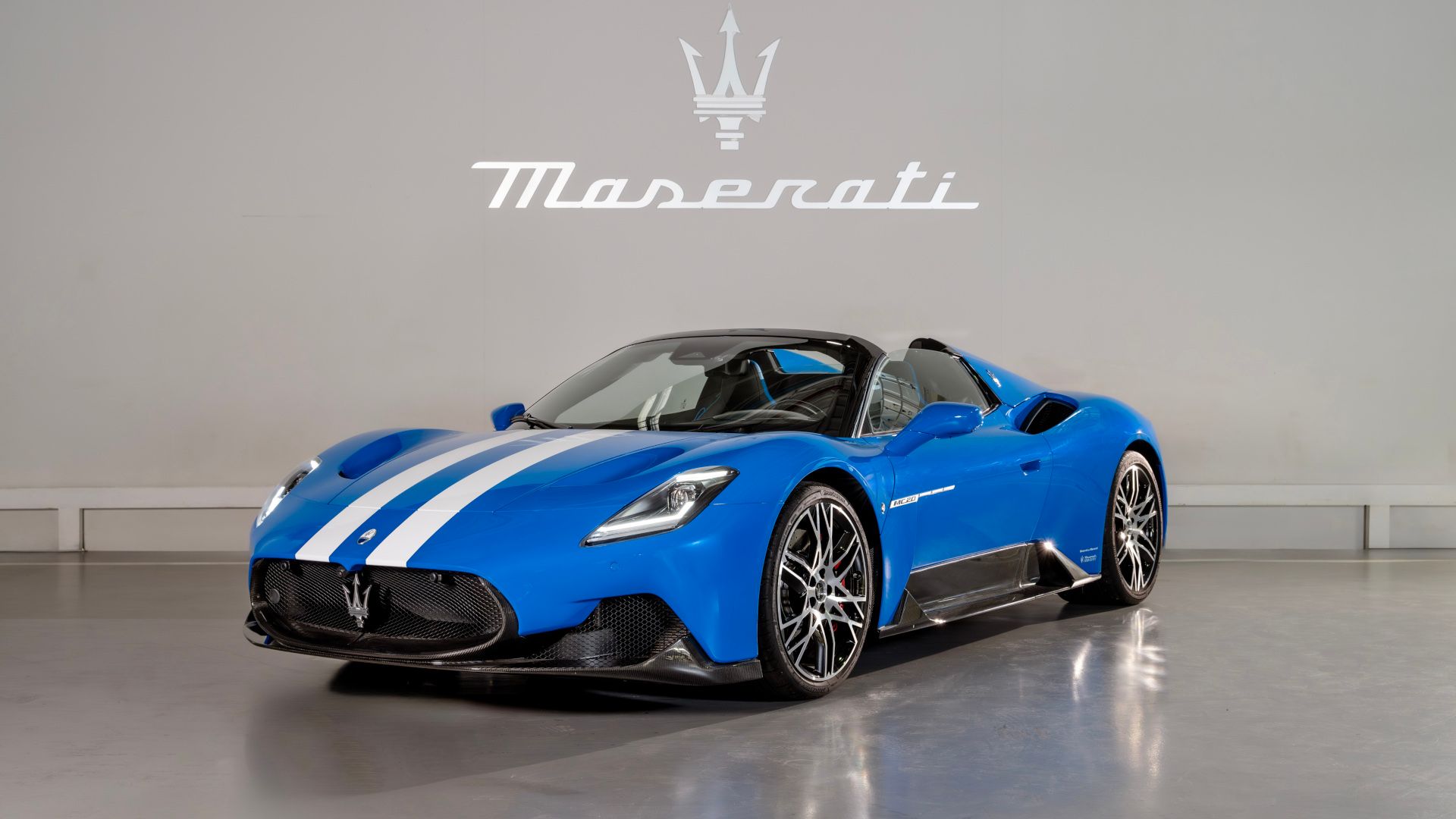
Maserati has spent the better part of two decades trying to remember who it is. The MC20 is the most convincing answer it has offered in years. Unveiled in September 2020 at the Modena Autodromo—a symbolic homecoming for a marque that had drifted through Ferrari stewardship and then into the arms of Stellantis—the mid-engined supercar landed as both a technical statement and a commercial plea. Here, at last, was the first Maserati designed, engineered, and built entirely in-house since the 3200 GT of the late 1990s.
The hardware is genuine. A carbon-fibre monocoque developed with Dallara. The Nettuno engine: a 3.0-litre twin-turbo V6 producing 630 horsepower, running a Formula 1-derived pre-chamber combustion system and a dry sump. By any honest measure, this is a real supercar. The question that has shadowed it from the start is whether a real supercar is what Maserati actually needed.
The Crisis Was Never at the Top
The uncomfortable truth is that Maserati's problem has never been desirability at the top of the range—it has been the middle. The Ghibli and Quattroporte sedans, once the brand's volume backbone, have aged into irrelevance in a segment where the Porsche Panamera and a phalanx of German and British rivals offer sharper dynamics and better residuals. The Levante, Maserati's first SUV, enjoyed a brief commercial moment around 2017 before resale values collapsed and fleet registrations diluted the badge. The Grecale, launched in 2022 as the volume play on the Giorgio platform shared with the Alfa Romeo Stelvio, arrived into a market already saturated with premium compact SUVs and has struggled to gain traction.
The sales figures tell the story bluntly: global deliveries hovered around 11,000 units in 2023, a fraction of what the brand projected during the heady Stellantis merger years, when plans for a Ghibli EV and a revived GranTurismo Folgore were meant to carry Maserati to 75,000 annual sales by 2025.
A Credibility Deposit
Against that backdrop, the MC20 functions less as a product than as a credibility deposit. It gives the brand a legitimate claim to performance heritage at a moment when showroom traffic is thin, and it supplies the technical halo—the Nettuno engine, the carbon tub, the sub-2.9-second 0-100 km/h sprint—that marketing departments use to justify premium positioning across the range.
The halo has been extended carefully. The MC20 Cielo, the retractable-hardtop spider introduced in 2022, widened the appeal. The GT2 racing variant and the MCXtrema track-only special—limited to 62 units, all pre-sold—demonstrated that Maserati could still build cars enthusiasts genuinely covet. And the GranTurismo Folgore, the brand's first battery-electric production car, borrows the MC20's performance narrative and applies it to a grand tourer, though its six-figure price tag places it well outside volume territory.
The MC12 Precedent
The historical parallel Maserati executives surely have in mind is the MC12, the Enzo-derived GT1 car of 2004 that briefly restored the tricolore's racing lustre during the darkest years of the Fiat era. The MC12 sold 50 road cars and did nothing to arrest the brand's commercial decline—but it kept the flame alive long enough for the GranTurismo of 2007 to become a genuine hit.
The MC20 may be playing a similar long game. Its success is real: the production run is effectively sold out through 2025, and the waiting list itself is a form of marketing that money cannot buy. But a halo car, however brilliant, cannot substitute for a competitive sedan and SUV lineup. It can only buy time.
Buying Time Under Stellantis
That time is now being spent under Stellantis CEO Carlos Tavares, whose public comments about brands that "burn cash" have not gone unnoticed in Modena. Maserati's future depends on whether the Grecale Folgore, the electric GranCabrio, and a promised large electric SUV can convert the MC20's glow into showroom traffic.
The supercar has done its job: it has made Maserati interesting again, and it has proven the engineering capability the brand spent years outsourcing. Whether it can save a company that still cannot sell a convincing four-door is a question no carbon-fibre monocoque can answer on its own.
What the MC20 ultimately reveals is a philosophy Maserati has always known in its bones: that the point of building cars is to build one worth dreaming about. The trident has never been a badge of sensible choices. It is a badge of passion, of Modena noise and sculpted haunches, of the unreasonable made real. The MC20 proves that spirit survives. The work now is making sure the rest of the range is worthy of standing beside it—because a halo, however bright, only illuminates what it touches.