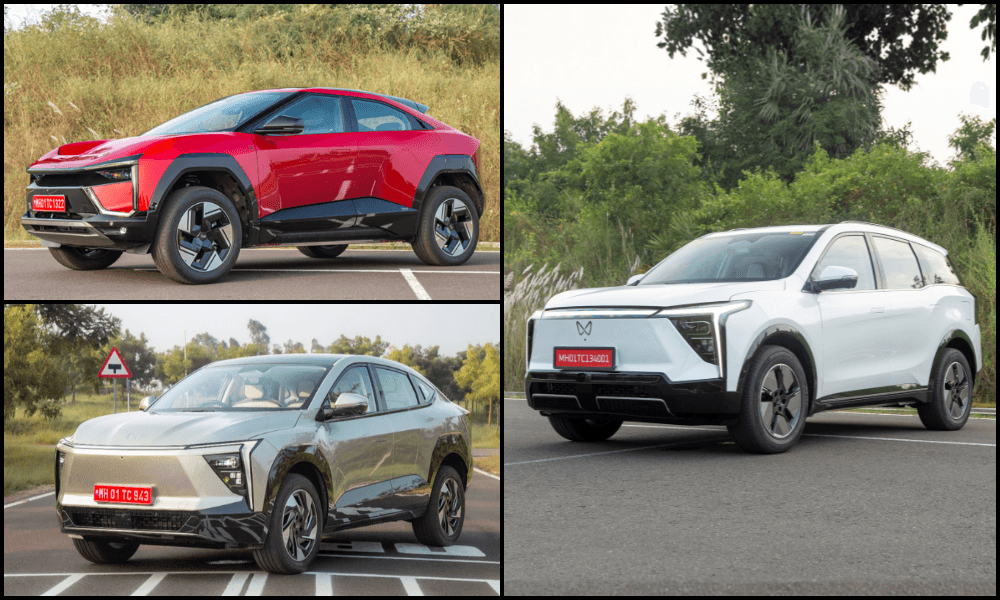
Mahindra has crossed one lakh electric SUV billings in under two years. Anand Mahindra marked the moment with characteristic public enthusiasm, and the milestone deserves genuine recognition. Building a credible EV franchise in India — a market where charging anxiety, price sensitivity, and entrenched petrol habits have humbled far larger global players — is no small achievement. The XEV 9e and BE 6 have found buyers among premium urban consumers, ministers have adopted the XEV 9e as a statement of forward-thinking governance, and the "Electric Origin" branding has successfully separated Mahindra's EVs from the retrofit-and-compromise perception that dogs much of the segment. By any conventional scorecard, this is a success story.
But the more revealing number came not from the milestone announcement, but from the company's own admission alongside it: Mahindra could sell 3,000 more EVs every month if supply constraints eased. Read that again. The company is not celebrating demand it created — it is apologising for demand it cannot meet. That single sentence reframes the entire narrative. The one lakh figure is not a ceiling Mahindra reached; it is a floor imposed on it by battery supply, component availability, and manufacturing bandwidth. The real story of Mahindra Electric in 2025 is not the sales it recorded, but the sales it forfeited.
A Different Kind of Problem
This is a fundamentally different problem from the one most EV makers in India face. Tata, Hyundai, MG, and the incoming wave of competitors are fighting for demand — discounting, extending warranties, and subsidising financing to coax hesitant buyers into the electric fold. Mahindra, by contrast, is fighting for supply. Its order books for the XEV 9e and BE 6 have consistently outrun its ability to deliver, and the wait times that result are not merely an inconvenience; they are a quiet invitation for rivals to intercept impatient buyers. Kia's Syros EV and the looming competition in the sub-4-metre electric crossover space are already positioning themselves against Mahindra's XUV 3XO EV, and every month a customer spends waiting is a month they spend shopping.
The Capital Is There. The Cadence Isn't.
The company clearly understands the stakes. Mahindra has announced plans to double electric SUV capacity over the next five years, and its broader capacity expansion — backed by a quarterly profit surge that beat analyst forecasts and mid-to-high-teens SUV growth expectations — signals that the capital is available. The pipeline reinforces the ambition: the BE 07 and Vision T are waiting in the wings, and Mahindra's platform strategy, built around the INGLO architecture, is designed to scale across body styles and price points. The strategic architecture is sound. The question is execution velocity.
The Asterisk on the Milestone
Here is where the milestone deserves a more critical reading. A supply-constrained 1 lakh is a very different animal from a demand-constrained 1 lakh. The former suggests a company with a product the market wants and a factory that cannot keep up — a problem of success. The latter suggests a company that has built more than it can sell. Mahindra's own guidance places it firmly in the first category, and that is genuinely the better problem to have. But it is still a problem, and it is one that compounds. Every quarter of constrained supply is a quarter in which competitors establish footholds, charging networks mature around rival ecosystems, and the novelty advantage of Mahindra's design-led EVs erodes.
There is also a subtler risk in the celebration itself. Milestones can lull organisations into treating constraint as vindication — "we sold out, therefore we succeeded" — when the honest interpretation is "we could have sold far more and didn't." Mahindra's leadership appears awake to this, given how openly the 3,000-a-month figure was volunteered. That candour is admirable, and it is strategically correct: it signals to investors and suppliers that the bottleneck is being addressed rather than disguised.
The one lakh milestone, then, is best understood as a proof of concept rather than a proof of scale. Mahindra has demonstrated that Indian buyers will pay premium prices for well-engineered, well-designed electric SUVs from an Indian brand. What it has not yet demonstrated is that it can build them fast enough to matter. Until the supply chain catches up to the order book, every Mahindra Electric press release will carry an implicit asterisk — and the company's real achievement will remain just out of reach, waiting on a factory floor rather than a showroom.