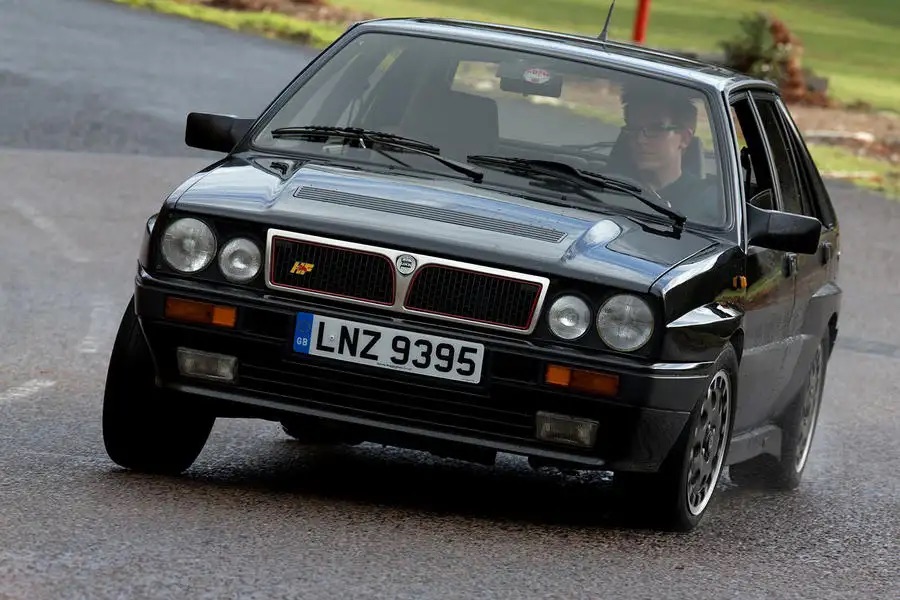
There is no badge in motoring quite so loaded as HF Integrale. Three syllables that conjure mud-spattered Sardinian stages, boxy fenders swollen over gold wheels, and a turbocharged four-pot howling through forests at midnight. It is a name earned in the World Rally Championship, not in a wind tunnel or a focus group. So when word arrived that Lancia intends to affix it to the 2027 Gamma HF Integrale — a 370-horsepower electric flagship debuting at the 2026 Paris Motor Show — the reaction split cleanly in two. Purists reached for the smelling salts. Everyone else leaned in.
Let us be honest about what the badge has meant. The Delta HF Integrale won six consecutive WRC manufacturers' titles between 1987 and 1992, a record that still stands as one of motorsport's great monopolies. It was homologation made flesh: a road car that existed because the rules demanded it, sold to the public with the rough edges left deliberately intact. To attach that name to a battery-electric crossover is either the most cynical act of brand necromancy in recent memory or the most confident one. Context suggests the latter.
A Marque Rebuilt from Ashes
Lancia, after all, has spent four decades as a ghost. The marque that gave us the Stratos, the 037, and the Delta was reduced to a single model sold in a single country, its heritage trotted out at concours events while its showrooms emptied. The revival now underway is not incremental. The new Gamma arrives in three distinct versions at Paris, and the range-topping HF Integrale carries 370 horsepower, all-wheel drive, and a name the engineers know they will be judged against. Stellantis has not been subtle about the intent: Italy at the heart of the project, heritage as the foundation, not the decoration.
The Heresy Argument
The heresy argument rests on a genuine truth. Electrification removes the very things that made the Integrale legendary — the lag, the boost, the mechanical violence of a turbocharged engine straining against a homologation special's compromised chassis. An electric motor delivers its torque instantly and silently, which is precisely the opposite of what an HF Integrale felt like. You did not drive an Integrale so much as negotiate with it. There was always the sense that the car was tolerating you.
Character Can Be Authored in More Than One Language
But badges are not engineering specifications. They are promises about character, and character can be authored in more than one language. What made the Integrale special was never the turbocharger alone; it was the audacity, the refusal to be sensible, the sense that the car had been built by people who cared more about winning than about comfort. A 370-horsepower electric flagship with rally-derived torque vectoring and a chassis tuned by engineers who grew up worshipping the original can absolutely honour that spirit. The question is whether Lancia has the nerve to make it feel dangerous.
The timing is instructive. Interest in Lancia's back catalogue has rarely been higher — a reborn 037 with twin-charging recently headed to auction carrying a $1.3 million estimate, and the Stratos remains among the most coveted cars ever built. Heritage sells, but it also indicts. Every modern Lancia will be measured against machines that had nothing to lose. The HF Integrale badge raises that measurement to an impossible standard, and Lancia knows it.
That is why this is genius rather than heresy. A cautious electric crossover would have been forgotten within a model cycle. A car that dares to wear the most sacred letters in rallying invites the argument, and the argument is the point. Lancia is not asking to be compared to its past; it is demanding it. Whether the Gamma HF Integrale deserves the badge will be settled on the road, not in the press release. But a brand with nothing left to prove would never have risked the question.