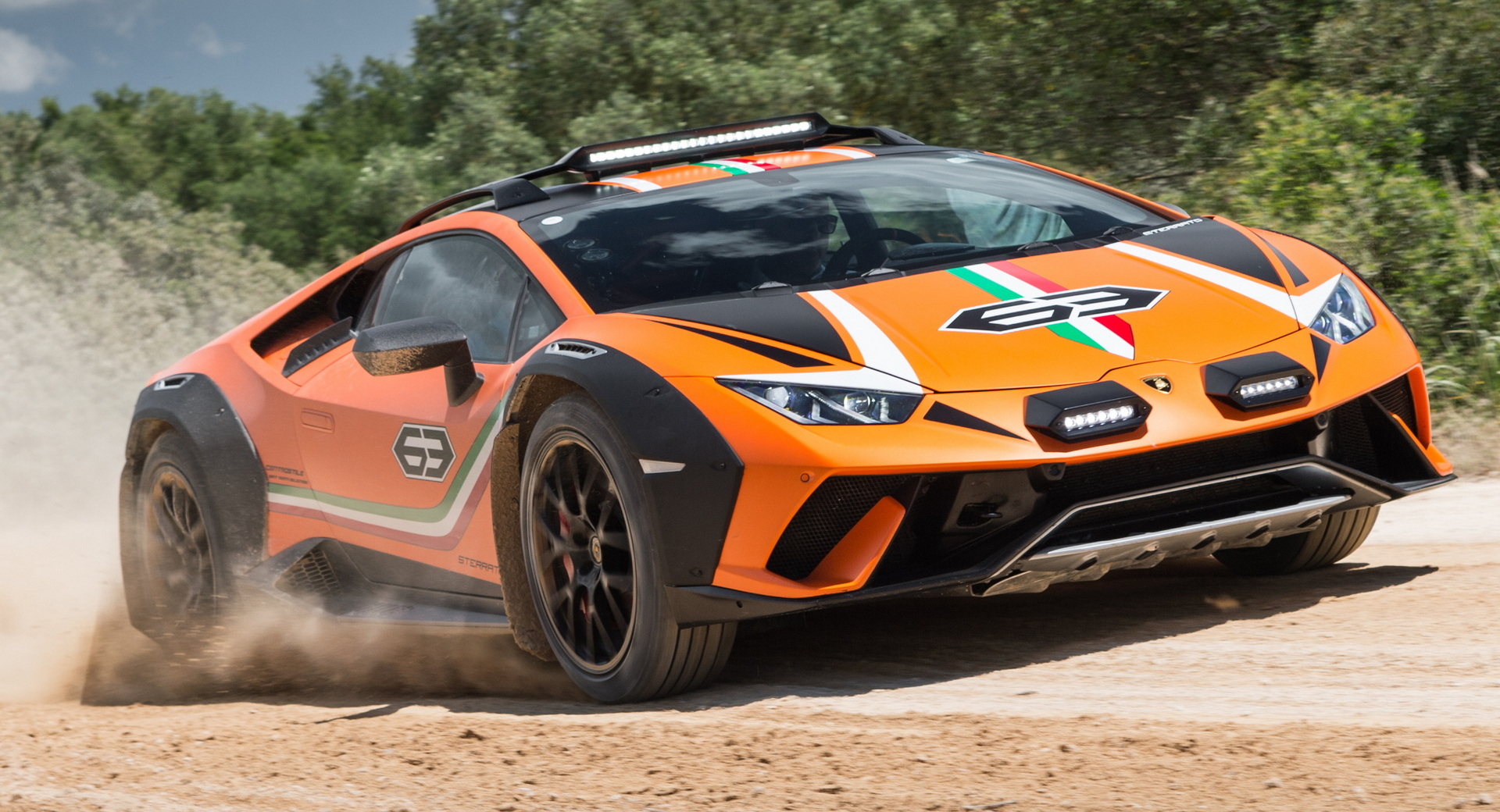
For decades, the supercar playbook was written in one language: lower, lighter, faster. Every gram of excess was stripped away, every millimetre of ride height sacrificed at the altar of the lap time. Lamborghini, perhaps more than any other marque, built its modern identity on that creed — the Countach's wedged aggression, the Diablo's 200-mph bombast, the Aventador's carbon-fibre theatre. But a quiet, dust-kicking revolution is underway in Sant'Agata Bolognese, and the company's persistent hints about a Temerario Sterrato suggest the Italian marque believes the next frontier of supercar relevance isn't the apex of a racetrack corner — it's the trailhead at the end of a gravel road.
The signals are no longer subtle. Lamborghini executives have repeatedly left the door open for a rally-inspired version of the Temerario, the twin-turbo V8 hybrid that replaced the Huracán. Industry outlets have tracked the hints with growing certainty, and reports indicate the new platform will spawn multiple variants — some expected, and a few genuinely surprising. The logic is difficult to argue with. The Huracán Sterrato, a lifted, all-terrain send-off for the V10 era, was supposed to be a curiosity, a limited-run oddity for collectors with vineyards and private rally stages. Instead, it sold out almost immediately and became one of the most talked-about cars of its generation. Buyers, it turns out, were not merely tolerating the raised suspension and roof-mounted snorkel — they were enchanted by them.
The Sterrato Philosophy: Capability Over Lap Times
That enchantment reflects something deeper than novelty. As the broader industry hurtles toward electrification, raw acceleration has become democratised. A mid-range EV can now humble a hypercar off the line, and Lamborghini's own leadership has publicly acknowledged that supercars must offer more than straight-line speed to justify their existence. This is the crucial context for the Sterrato philosophy. If every fast car can be fast, then the differentiator becomes capability of a different kind — the ability to leave the tarmac entirely, to turn a mountain pass into a playground and a fire trail into a stage. Off-road supercars aren't a rejection of performance; they're a redefinition of it, trading a tenth of a second at the circuit for an entire dimension of experience.
The Business Case for Getting Dirty
There is also a commercial logic at work, and it's characteristically shrewd. Lamborghini has spent years cultivating a variant strategy that squeezes maximum life and margin from each platform — the Temerario is expected to follow the well-worn path of base car, hardcore SV derivative, and now potentially a rugged Sterrato sibling. Tuning houses are already circling; aftermarket specialists have begun sketching packages for the Temerario before customer cars have even settled into garages, a sure sign that the platform will be fertile ground for personalisation. Meanwhile, the brand's broader ecosystem continues to expand, from motorsport programmes that keep the racing DNA credible to collaborations that extend the name into consumer technology. A lifted, all-wheel-drive, hybrid-assisted rally supercar fits neatly into that expanding universe — it is, in essence, a lifestyle product that happens to be devastatingly quick.
Gimmick or Glimpse of the Future?
Sceptics will call it a gimmick, and they have a point: few Sterrato owners will ever genuinely ford a stream. But the same accusation was levelled at the SUV boom, and the Urus went on to become the company's commercial backbone. The truth is that modern luxury performance is as much about narrative as it is about numbers. A supercar that can conquer a gravel incline tells a better story than one that merely shaves a hundredth off a lap it will never see. It signals adventure, irreverence, and a refusal to be confined by convention — precisely the qualities that have always defined the most memorable Lamborghinis.
The Temerario Sterrato, if and when it arrives, will not be the fastest car the company has ever built. It may not even be the most focused. But it could well be the most telling — proof that in an era when speed is cheap and attention is priceless, the supercar's future may be found not on the smoothest asphalt, but on the roughest road it can find.