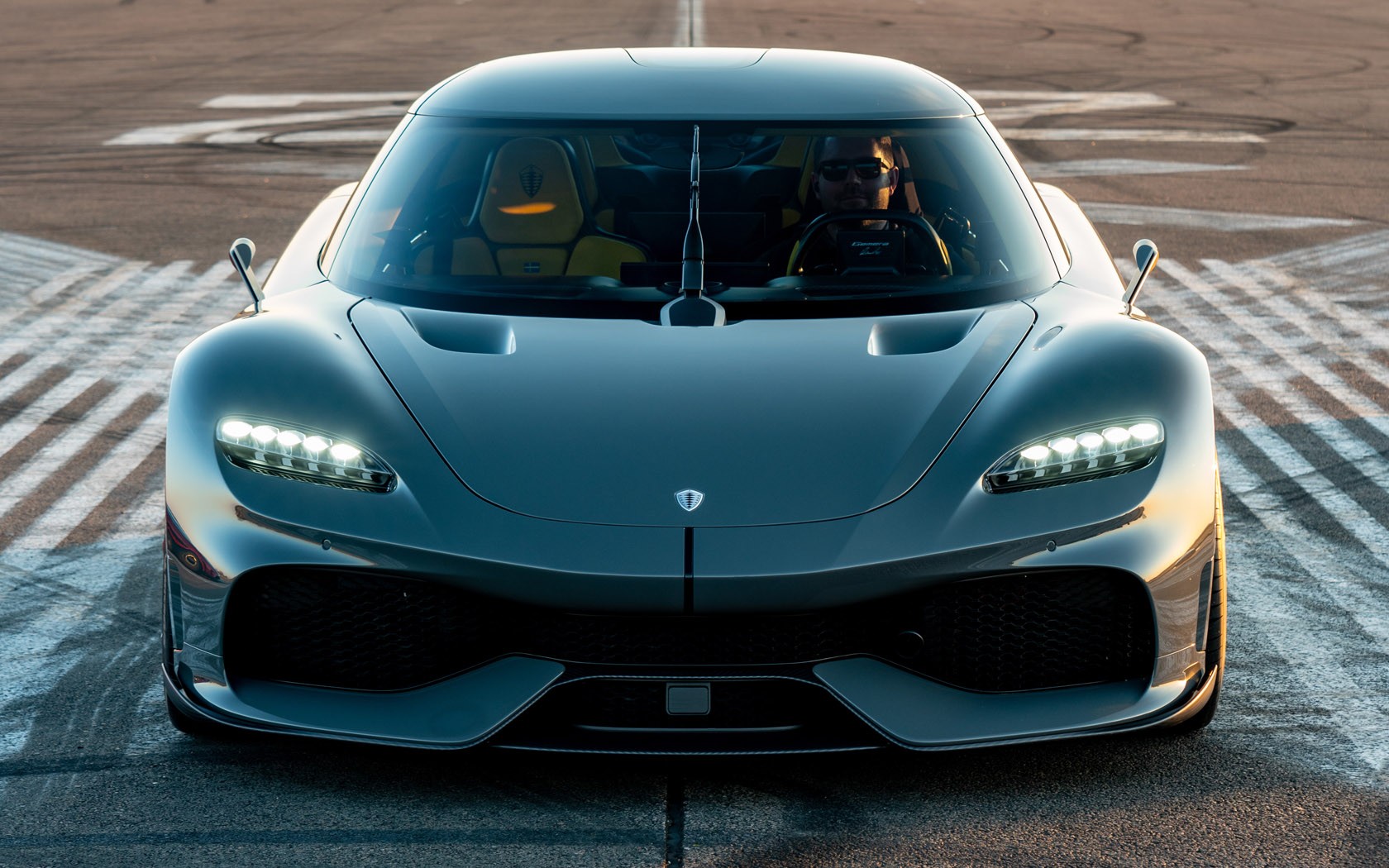
There’s a particular kind of pain that only a car enthusiast understands when they see a masterpiece desecrated. The images from a Copenhagen luxury hotel were enough to make anyone wince: a Koenigsegg Gemera, the first customer-delivered example of the Swedish marque’s four-seat, 2,300-horsepower mega-GT, sitting with shattered glass, dented doors, and smashed mirrors. The owner had taken delivery just fourteen days prior. The damage wasn't the result of a high-speed impact or mechanical failure—it was someone hurling stones at the car while it sat unattended overnight, under the watchful eye of hotel doormen who reportedly saw nothing. It’s a gut-punch for the owner, but it also exposes a truth that extends far beyond this single, unfortunate vehicle: the economics of owning a hypercar aren't just about the astronomical purchase price, but about the hidden, brutal fragility that follows you everywhere you park.
When someone writes a check for roughly $3 million, they aren't just buying a machine—they're buying into a carefully curated ecosystem of exclusivity, engineering genius, and, crucially, protection. The Gemera is a technical marvel: a plug-in hybrid with a twin-turbocharged three-cylinder engine and three electric motors that collectively produce more power than any production car before it. It's a masterpiece of packaging, seating four in carbon-fiber luxury. Yet, as the Copenhagen incident proves, all that innovation is housed in a skin of carbon fiber and glass that's remarkably vulnerable to the random, mindless cruelty of the outside world. The very rarity that makes the car so covetable—the fact that it's one of only a handful in existence—is the same factor that makes any repair a logistical nightmare.
The $150,000 Repair Bill That's Really a Bespoke Engineering Project
Consider the repair estimate: somewhere in the region of $150,000. For a standard vehicle, a smashed window and a dented door would be a routine insurance claim. For a Koenigsegg, it's a bespoke engineering project. The body panels aren't stamped steel; they're hand-laid carbon fiber, cured in autoclaves and painted in facilities that are themselves works of art. The glass isn't off-the-shelf; it's shaped to the car's aerodynamic curves and must be flown in from a specialized supplier. The mirrors house cameras and sensors that must be calibrated by technicians who likely have to travel from Sweden.
This isn't a trip to the local body shop—it's a logistical operation that could take months, leaving the owner with a $3 million paperweight in a secure garage. The financial loss is one thing, but the temporal loss is another. A hypercar is a toy, and a toy that's in the shop for half a year is a toy that has lost its purpose. The economics of ownership extend far beyond the initial purchase; they encompass every mile driven, every parking spot chosen, every moment of exposure.
The Owner as a Public Target
This incident also highlights a darker, more uncomfortable aspect of hypercar ownership: the transformation of the owner into a public target. The news cycle, fed by outlets from Road & Track to Carscoops, has turned this vandalism into a global story. The owner, whose name has been carefully withheld, is now a symbol of wealth and its discontents. The act of vandalism wasn't a crime of opportunity; it was a statement, a violent act of resentment aimed at an object that represents an insurmountable economic chasm.
This isn't a new phenomenon, but the hypercar era has amplified it. A Ferrari or a Lamborghini, while still exotic, is a known quantity. A Koenigsegg, with its alien styling and unheard-of performance figures, is a lightning rod. It demands attention, and that attention isn't always benevolent. The very design language that draws crowds at motor shows—the aggressive aero, the dramatic doors, the sheer visual mass—becomes a liability in the real world.
The Cruel Paradox of Enjoyment
The owner of this Gemera now faces a cruel paradox. To enjoy the car, he must expose it. To drive it, he must park it. And to park it, he must accept that it is a target. The hotel doormen, the security cameras, the gated garage—none of it is a guarantee against a determined, or even a random, act of malice. The fragility here isn't just physical; it's the fragility of the entire ownership proposition.
The dream of owning a Koenigsegg is predicated on the idea of mastery—mastery over engineering, over roads, over the very notion of automotive limits. But the vandal in Copenhagen has shown that the owner isn't the master of his car's fate. He's merely its custodian, and the world outside his garage is a hostile environment. Every hypercar owner knows this on some level, but incidents like this force it into the harsh light of day.
The Unspoken Clause in the Hypercar Contract
This is the unspoken clause in the hypercar contract. The purchase price buys you the car, but it doesn't buy you security, peace of mind, or immunity from the chaos of the world. It buys you a responsibility that is as heavy as the carbon fiber itself. The Gemera will be repaired, likely at the manufacturer's own facility, with the kind of painstaking care that only Koenigsegg can provide. The owner will get his car back, and he will drive it again.
But the next time he leaves it outside a hotel, even for a moment, he will wonder. And that wondering is the true cost of ownership. It's a cost that no amount of money can fully cover, and it's a cost that every hypercar owner must eventually confront. Koenigsegg has always built cars that push the boundaries of what's technically possible—machines that redefine the limits of speed and engineering. But the Copenhagen incident reminds us that the most fragile component in any hypercar isn't the carbon fiber or the glass or the electronics. It's the world it has to live in. And that's a reality no amount of Swedish engineering can fully protect against.