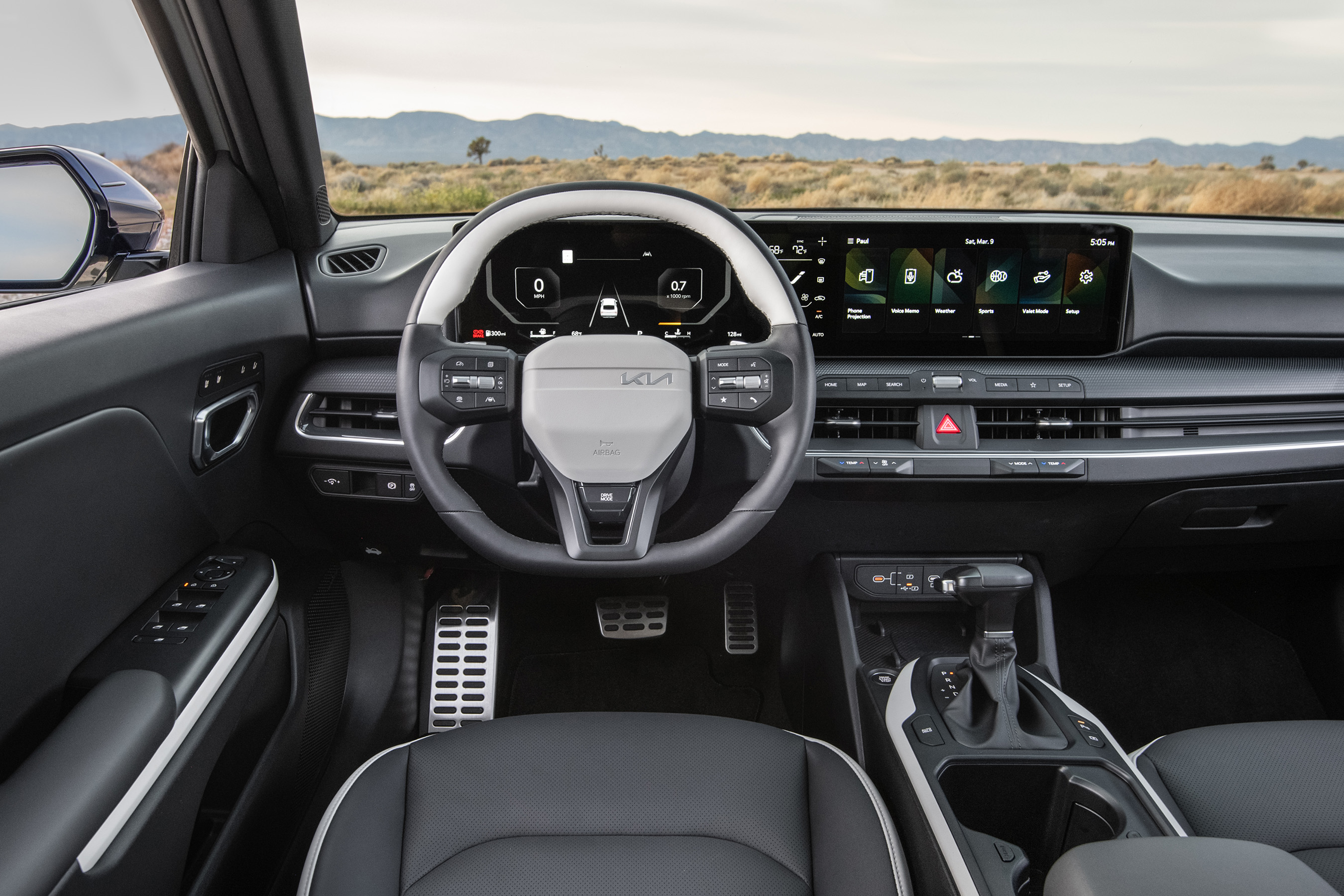
The most interesting thing happening in Kia's lineup right now isn't under the hood of the EV3, and it isn't hiding in the bluff, boxy flanks of the Telluride. It's sitting right there on the dashboard of the company's next-generation sedans: a wider, more prominent central display running a software suite borrowed from Hyundai. Recent spy shots of an upcoming Kia sedan interior confirm the direction — a larger screen, a cleaner layout, and the parent group's high-tech stack doing the talking. For a brand that built its reputation on value and styling, the cabin is suddenly the headline.
This is a meaningful shift in positioning. For years, Kia's four-doors — the K5, the departed Stinger, the compact Forte — were sold on price, looks, and driving dynamics. The interior was competent, rarely the reason you walked into the showroom. That calculus is changing. As Hyundai Motor Group consolidates its software development around its connected car Operating System and next-generation infotainment architecture, Kia's sedans are emerging as the cleanest canvas for deploying it.
Why the Sedan, of All Things
Sedan buyers tend to be commuters and tech-forward professionals — an audience that rewards seamless connectivity and over-the-air updates far more than rugged trail capability. That makes the sedan the logical place to showcase a digital ecosystem, not the off-roaders or the family haulers. A commuter sitting in traffic cares about how the interface responds, how quickly the maps load, and whether the car gets better six months after purchase. That's a software story, not a horsepower story.
The strategic logic here runs deeper than screen size. Hyundai and Kia share platforms, powertrains, and increasingly, software — but they do not share brand identities, and that distinction matters. Hyundai has leaned into futuristic design and its Ioniq sub-brand to carry the technology banner. Kia, meanwhile, has built momentum through design-led hits like the EV6 and EV9, and through value plays like the recently priced EV3, positioned as America's most affordable long-range EV. Slotting Hyundai's software into Kia's sedans lets the group amortize development costs across two brands while giving Kia a technological credibility it hasn't always commanded in the passenger-car segment.
The Competitive Math
There's also necessity at work. The mid-size and compact sedan segments are no longer decided by horsepower alone. Rivals from Toyota, Honda, and a resurgent domestic field are all investing heavily in user interfaces, voice assistants, and subscription-adjacent digital services. A larger, faster, more capable infotainment system is table stakes now. By adopting Hyundai's software rather than developing a parallel system, Kia can iterate faster, push updates to existing vehicles, and keep its sedans relevant in a market where the cabin experience often outweighs the drivetrain in the final purchase decision.
The timing is shrewd. Kia's broader lineup is firing on multiple cylinders — the EV5 has drawn praise as well-equipped and well-priced, the EV3 is generating genuine affordability buzz, and the Telluride remains a benchmark in its class. Even the brand's cultural footprint is expanding, from WNBA Rookie of the Year honors to NBA award tracking. Against that backdrop, upgrading sedan interiors with premium software reinforces a narrative of upward mobility rather than cost-cutting. It tells buyers that the technology in a $28,000 Kia sedan descends from the same engineering that powers the group's flagship EVs.
With Software Comes Scrutiny
Of course, software leadership carries obligations. Hyundai and Kia continue to face legal exposure over vehicle security vulnerabilities, with the 9th Circuit ruling reopening the door to substantial litigation and cities like Columbus settling over theft concerns. A brand asking customers to trust its digital ecosystem must also demonstrate that the underlying vehicle architecture is secure. Every added connected feature raises the stakes on cybersecurity, and Kia's software-forward sedans will be judged on both fronts simultaneously — convenience and vulnerability, in the same cabin.
The Quiet Realignment
What's emerging, then, is a quiet realignment. Kia's sedans are no longer just the value alternative in the showroom. They are becoming the group's software showcase — the place where Hyundai's digital investment meets Kia's design sensibility and pricing discipline. If the strategy lands, the next K5 or its successor may be remembered less for its warranty and more for its interface.
In an industry where the dashboard has become the new battleground, that would be a meaningful transformation for a brand long defined by what it cost rather than what it could do. Kia's automotive philosophy has always been about giving more than the sticker suggests. Now it's applying that same logic to software — and betting that the most persuasive argument for the brand won't come from a spec sheet, but from the screen you touch every single morning.