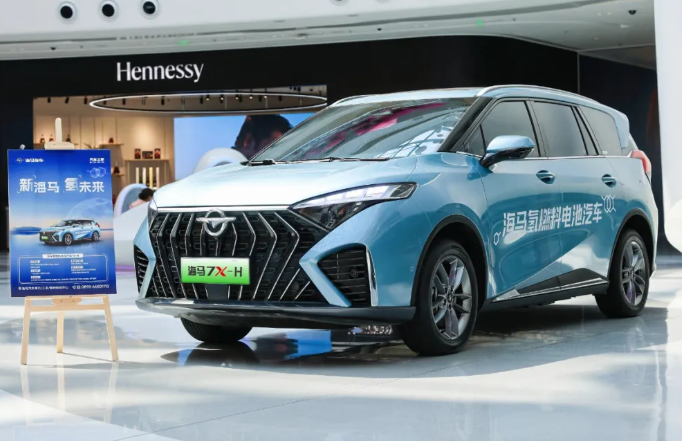
The confirmation that Haima Automobile intends to enter India lands with a curious thud. Here is a marque that once built more than a hundred thousand vehicles a year, that cut its teeth alongside Mazda in its formative years, and that now arrives at the gates of the world's most punishing car market carrying only a fraction of that momentum. The question is not whether Haima can build a car — it plainly can. The question is whether anyone in India will care.
The news, reported this week, will be parsed closely by every analyst in Pune and Gurugram. And well it should be, because Haima's story is a case study in what happens to a carmaker that lets its product cadence slip while rivals sprint ahead.
From Mazda Protégé to Market Also-Ran
It is worth recalling what Haima once was. Founded in Haikou, Hainan, in the late 1980s as a joint venture with Mazda, the company spent its early decades assembling licensed Mazda platforms — the Familia, the 323, the Premacy — and selling them to a Chinese middle class only just learning to buy cars. For a time, the formula worked spectacularly. Haima's sedan line, particularly the Family and later the M3, earned a reputation for sensible engineering at a sensible price.
But the Chinese market did not stand still. Domestic rivals like Geely, Changan and BYD poured capital into design, electrification and software, while Haima's product cadence slowed. By the mid-2010s its volumes had collapsed; by the 2020s its relevance at home was marginal at best. Haima, in short, is a brand that missed its own inflection point — a cautionary tale written in sheet metal.
The Hardest Market on Earth
Which makes the India gambit either bold or desperate, depending on your reading. India is, by any measure, the hardest automotive market on earth to crack — not because Indians are hostile to foreign brands, but because the incumbents are ruthless. Maruti Suzuki commands roughly forty percent of the market through a distribution network and cost structure no newcomer can replicate. Hyundai has spent three decades building brand equity that now rivals the Japanese. Tata and Mahindra have reinvented themselves around SUVs and, increasingly, electric vehicles.
And the Chinese brands that have tried — MG with its Hector, and more recently BYD at the premium end — succeeded not by being cheap but by being conspicuously better-equipped, better-styled and better-marketed than the price suggested. Haima, whose current global lineup skews toward modest sedans and ageing crossovers, offers no such proposition. There is no halo car here, no design language that stops traffic, no driving feel pitched as a reason to buy rather than a box to tick.
The Burden of a Faded Name
There is also the matter of the name itself. A quick scan of recent news returns a typhoon, a cold seep in the South China Sea, a solar project in Oman, a synthetic-platelet biotech spinout and a handful of obituaries. None of it is about cars. That is the burden Haima carries: a brand so faded that its name no longer signals anything in the global conversation.
In India, where buyers research obsessively and resale value is a religion, an unknown marque with no dealer network, no service footprint and no residual-value history is a hard sell. The Chinese-origin tag, meanwhile, carries its own geopolitical friction — something MG has navigated adroitly by emphasising its British heritage and local manufacturing, a playbook Haima would need to adapt rather than copy.
A Credible Path, Narrowly Drawn
None of this is to say the attempt is doomed. India rewards patience and punishes arrogance in equal measure, and there is a credible path for a value-focused entrant willing to localise aggressively, lead with an SUV rather than a sedan, and price below the Koreans without looking cheap. Haima's engineering heritage is real, and its small-car experience is not irrelevant.
But the brand would be arriving a decade late to a party where the guest list is already set and the music is loud. To crack India, Haima will need more than a confirmation of intent. It will need a product, a price and a promise compelling enough to make Indian buyers forget they have never heard of it. On current evidence, that is a tall order.
What Haima once understood — that sensible engineering at a sensible price is its own kind of poetry — remains the right philosophy. Whether it can still write that poem in a market this unforgiving is the only question that matters.