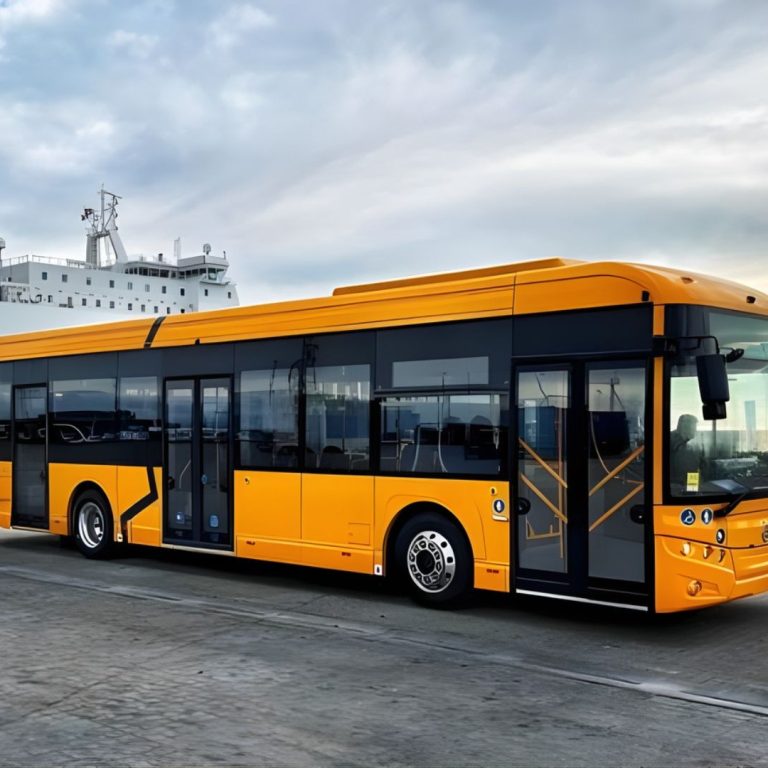
Mention "Golden Dragon" and most people picture a shimmering float in a Lunar New Year parade or a menu item at a dim sum house. But the most consequential bearer of that name is doing something far more interesting than feeding crowds or entertaining them. On the industrial fringe of Xiamen, a commercial vehicle manufacturer is pulling off a technical sleight-of-hand that should have every transit authority and OEM executive sitting up straight. Golden Dragon, the bus builder, has just rolled out the first carbon-fiber articulated electric bus for Dutch partner Ebusco — and in the process, it has vaulted past a generation of conventional EV engineering. This isn’t another Chinese factory stamping out anonymous battery boxes for export. This is a statement about material science, manufacturing nerve, and where heavy-vehicle innovation actually lives now.
The machine in question is the Ebusco 3.0 platform, stretched into articulated duty and cloaked in carbon-fiber-reinforced polymer (CFRP) from nose to tail. For decades, transit buses have been welded together from steel and aluminum, a orthodoxy so ingrained it feels like gravity. Golden Dragon and Ebusco just bent that gravity. By building the entire body structure from CFRP, they’ve achieved a mass reduction of roughly 30 percent compared to a comparable standard bus. On an electric vehicle, that’s not a nice-to-have; it’s everything. Every kilogram shed is a kilogram the battery doesn’t have to haul. That translates directly into extended range, reduced tire scrub, and — critically — the ability to spec a smaller, cheaper battery pack and still hit the same operational radius. On a 60-foot articulated bus, that’s not a marginal gain. That’s a paradigm shift in total cost of ownership.
The Factory Floor Alchemy
Let’s be clear: carbon fiber isn’t new. Aerospace has been wrapping planes in the stuff for half a century. The trick Golden Dragon has pulled off isn’t the material — it’s making the material viable at commercial scale. Carbon fiber’s curse has always been its labor intensity and glacial curing times, which have historically confined it to low-volume, high-margin niches like supercars and fuselages. The Xiamen facility has industrialized the process with automated fiber placement and resin transfer molding that slash cycle times from hours to minutes. The factory floor, once a symphony of welding sparks and stamped steel, now hums with robotic arms laying carbon tow with surgical precision. This is the invisible revolution — not the bus itself, but the manufacturing alchemy that renders it economically reproducible. It’s the difference between a hand-built hypercar and a production vehicle, and Golden Dragon has crossed that line.
Why Europe Is Paying Attention
The implications for the European market, where these buses will soon be operating, are profound. Transit authorities across the continent are staring down ambitious decarbonization deadlines, but they’ve hit a stubborn paradox: electric buses are heavier than their diesel predecessors. That extra mass stresses road infrastructure and eats into passenger capacity thanks to gross vehicle weight regulations. Golden Dragon’s carbon-fiber approach dissolves that constraint. A lighter bus can carry more people or travel farther on a single charge — both critical metrics for urban operators scrutinizing every euro of their procurement budgets. The fact that Ebusco chose Golden Dragon over a European contract manufacturer is a pragmatic acknowledgment that China has pulled ahead in advanced composites for ground transportation. It’s not about cheap labor anymore; it’s about capability.
Crash Safety and the Repairability Question
Skeptics will raise the usual objections: what about crash safety and repairability? These are the traditional weak points for composite structures, and Golden Dragon has addressed them head-on. The bus uses modular panel designs, so a damaged section can be unbolted and replaced rather than requiring a whole-body teardown. Crash tests conducted during development reportedly surpassed EU structural integrity standards, thanks to the high specific energy absorption of the carbon layup. The company’s willingness to share crash-test data with regulators smoothed the type-approval process — a hurdle that has tripped up other Chinese entrants into the EU market. It’s a mature, engineering-led approach that acknowledges the real-world demands of a transit vehicle, not a lab experiment.
There’s also a geopolitical layer here that can’t be ignored. As Brussels and Washington spar over tariffs and technology transfer, Golden Dragon and Ebusco offer a more sophisticated path: joint development rather than export dumping. The Dutch side brings battery management software, powertrain integration, and a European service network. Golden Dragon contributes the composite chassis expertise that no one else can match at scale. It’s a division of labor that benefits both parties — and ultimately, the transit riders who will board these silent, featherweight behemoths in the coming years.
This is the story that deserves attention. Not a parade float, not a stock ticker, not a restaurant review. Golden Dragon has taken a fringe curiosity from trade show booths and turned it into production reality. The carbon-fiber articulated bus is rolling off the line, and soon it will be threading through the tight cobblestone streets of European cities with a grace that belies its size. The factory floor in Xiamen has spoken. The rest of the industry would be wise to listen — because the future of heavy transport isn’t just electric. It’s featherweight.