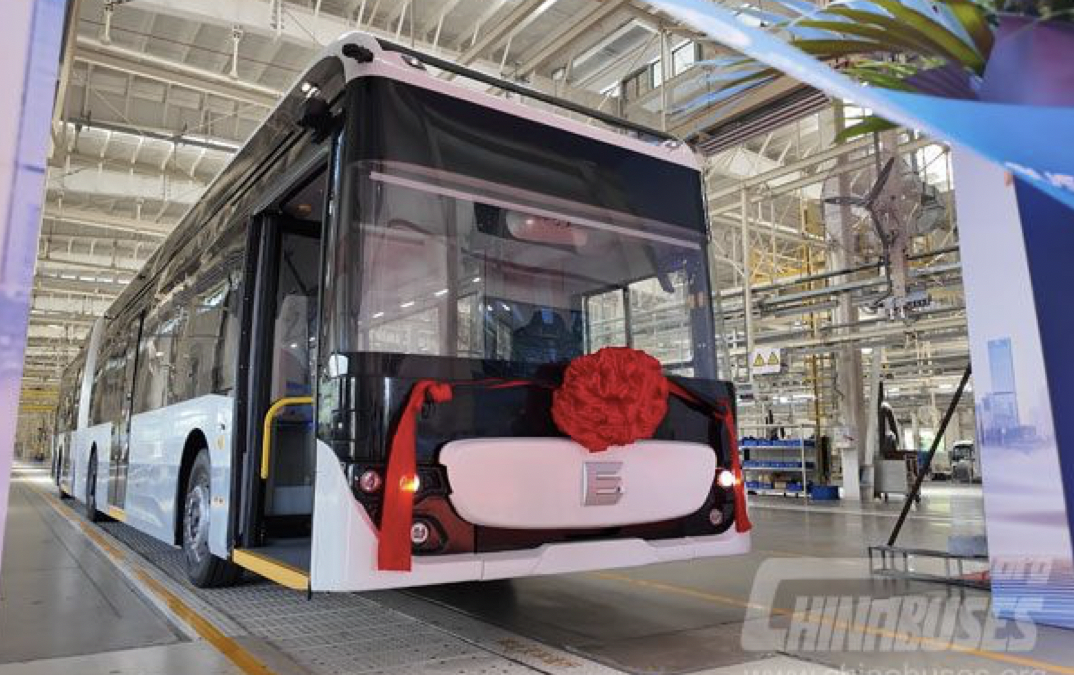
Golden Dragon Bus has spent decades perfecting the unglamorous machinery of public transit — the city bus, the airport shuttle, the school run workhorse. But a partnership with Dutch manufacturer Ebusco has quietly pushed the Chinese company to the bleeding edge of composite vehicle engineering. Together they've produced Europe's first carbon-fiber articulated electric bus, a machine that sheds weight with the ruthlessness of a racing program while carrying the passenger load of a small train.
It's a remarkable technical achievement in its own right. It's also the blueprint for something far more interesting.
The Weight Problem, Solved at the Root
Carbon-fiber construction is the single most effective lever available to an electric vehicle designer, because every kilogram removed from the chassis translates directly into range, payload capacity, or battery mass that no longer needs to be carried. In a bus, that math produces efficiency dividends. In an offroad rescue vehicle, it produces something closer to a transformation.
The case for an electric rescue platform has always foundered on the same objection: batteries are heavy, and heavy vehicles sink, bog, and stall where they are needed most. Golden Dragon's composite expertise attacks that problem at its root. A carbon-fiber monocoque or space-frame can cut structural mass by a third or more compared with conventional steel construction — and the reduction compounds when you no longer need the oversized battery pack required to drag all that steel through mud, sand, and snow. The Ebusco collaboration demonstrates that Golden Dragon can execute this kind of construction at production scale, not merely in a concept shop.
Instant Torque, Low Center of Gravity
What makes the prospect genuinely compelling, though, is the torque characteristic of electric drivetrains. An electric motor delivers maximum twist from zero revolutions — precisely the quality that matters when a vehicle is crawling over scree, winching through a riverbed, or climbing a gradient that would have a diesel engine hunting for its power band.
Combine instant torque with a low, flat battery floor that drops the center of gravity, and you have a vehicle with the traction and stability of a rock crawler wrapped in the silence that rescue work often demands. That silence is not a luxury. It's an operational asset on a search grid, where shouted communication and acoustic sensors matter more than engine note.
Manufacturing Scale Changes the Economics
Golden Dragon also brings something that boutique offroad builders cannot: scale. The company manufactures buses by the thousand, and its partnership with Ebusco signals access to European engineering standards and certification pathways. A low-volume rescue vehicle derived from proven composite bus architecture would inherit that manufacturing discipline, along with a supply chain already tooled for the material.
The economics of carbon fiber have always been the technology's Achilles' heel. But amortized across an established production line, the calculus shifts considerably. This is not a garage-built prototype chasing a niche. It's industrial capability looking for a new application.
Where the Need Is Real
The operational case writes itself. Mountain rescue teams, disaster response agencies, and remote infrastructure operators all work in environments where diesel supply lines are fragile and emissions are either irrelevant or actively harmful. An electric rescue vehicle that can be charged from a solar array at a forward base, that operates near-silently on a search grid, and that weighs hundreds of kilograms less than its steel equivalent would answer a genuine unmet need. Wildfire response crews, in particular, have spent years searching for exactly this combination of capability and clean operation.
None of this is on Golden Dragon's announced roadmap. The company is in the bus business, and its Ebusco partnership is aimed squarely at European transit electrification. But the underlying technology — lightweight composite structures married to proven electric drivetrains — is agnostic about the body it carries. The hard engineering has already been done. What remains is the imagination to point it somewhere other than a city street, and the commercial nerve to build a machine that the rescue world has been waiting for without quite knowing it.
Golden Dragon built its name on moving people through cities efficiently and without drama. The same philosophy — light, strong, quiet, relentless — could one day move them through the worst terrain on earth. That's not a pivot. That's a promise the brand has already kept once, in a different form.