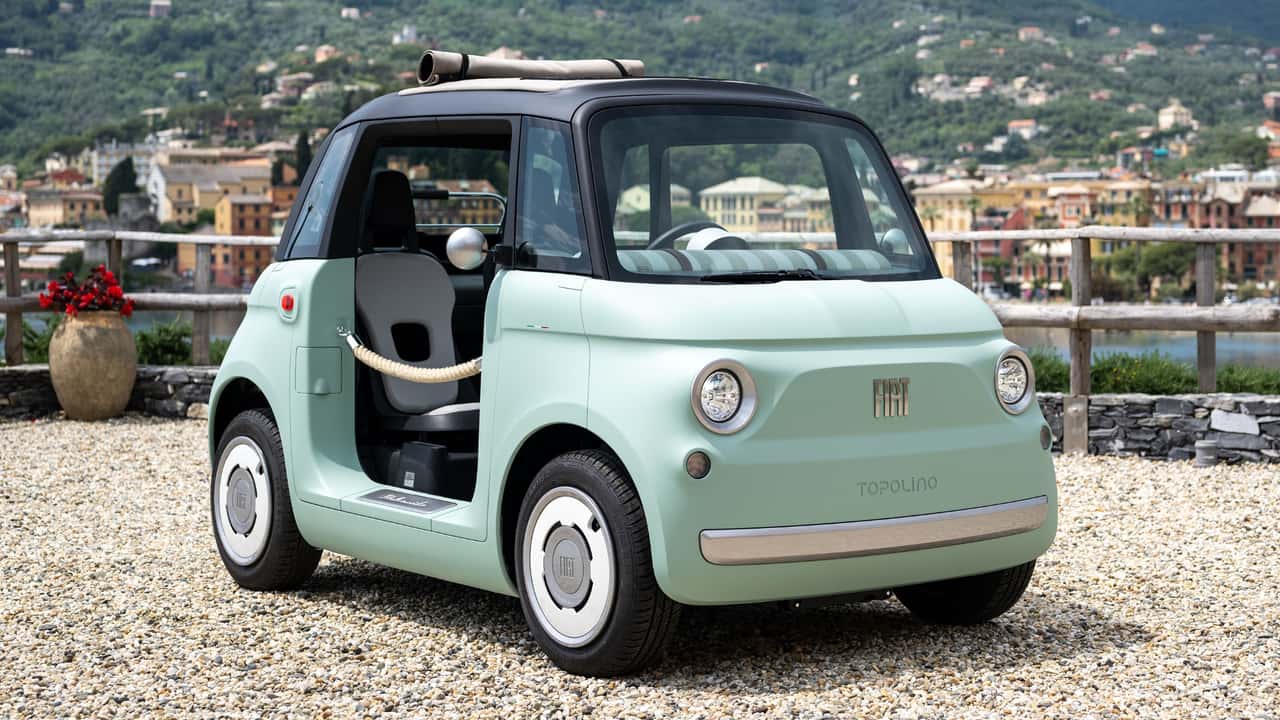
For a century, the American driveway has been defined by a simple arithmetic of excess: more horsepower, more seats, more sheet metal, more everything. Into this landscape of two-ton crossovers and full-size pickups now rolls the 2027 Fiat Topolino, a vehicle so defiantly, almost impishly small that it doesn't argue with American car culture so much as giggle at it. And according to the recent flurry of headlines confirming its arrival, the little Italian quadricycle has finally earned something it has chased for years: street-legal status in the United States. Within reason, of course.
The caveat is doing heavy lifting there, and it deserves to be confronted plainly. The Topolino remains a low-speed vehicle, capped at roughly 25 mph — a figure that renders it useless for the interstate and borderline theatrical on a suburban arterial. Yet the machine's official American arrival, reported widely as a $15,000 proposition, reframes the question entirely. This is not a car competing with a Corolla. It is a car competing with a second set of car payments, a golf cart, a Vespa, or the creeping realization that most household errands never exceed a few miles at low velocity. Judged on that ledger, the Topolino is not a compromise. It is a provocation with a license plate.
Small Car, Loud Statement
The design is the point, and Fiat knows it. The Topolino is unabashedly retro, a rolling wink to the original 1936 Fiat 500 that bore the same nickname — "little mouse" — and its proportions are closer to a scooter with delusions of grandeur than to anything in an American showroom. That this tiny object has been winning over American customers, as Stellantis' own announcements suggest, says something revealing about a market segment quietly exhausted by sameness.
Fiat has even dressed the thing in a collaboration with San Lorenzo, the Italian yacht builder, leaning into the fantasy that your neighborhood is the Amalfi Coast and your commute is a tender ride to shore. It is absurd. It is also the most honest expression of la dolce vita available for five figures.
The Physics Don't Care About Charm
There is, inevitably, a weight problem — Autocar has noted as much about Fiat's new four-seater — and the Topolino's charm doesn't exempt it from physics or from the compromises of its class. Low-speed vehicles are, by regulation, light, spartan, and limited in crash protection. Buyers expecting the hushed solidity of a conventional sedan will find something closer to a weatherproofed scooter.
But that critique misreads the assignment. Nobody buys a Topolino to replace a Camry. They buy it to replace a habit — the reflexive climb into two tons of steel to fetch a loaf of bread.
A Strange Little Beacon
What makes the Topolino genuinely interesting, though, is the timing. Fiat's broader American narrative has been uneven: Stellantis has endured a chip shortage that disrupted Fiat output in Italy and may linger through December, and the brand's product cadence has felt uncertain. Yet the Topolino arrives as a strange little beacon, and it previews a future — the electric Fiat Koala, pegged for a 2028 launch on a 2CV-derived platform, suggests the company is serious about tiny, affordable, characterful EVs. The Topolino is the opening argument in that case, delivered at 25 mph.
So yes, it is America's weirdest sedan alternative — weirder than a motorcycle with a roof, weirder than a golf cart with a VIN. But weirdness, in a market this monotonous, is a form of courage. The $15,000 Fiat Topolino doesn't ask to be your only car. It asks you to reconsider what a car is for. For a certain kind of buyer — urban, design-literate, allergic to the ordinary — that may be the most persuasive pitch on the lot.