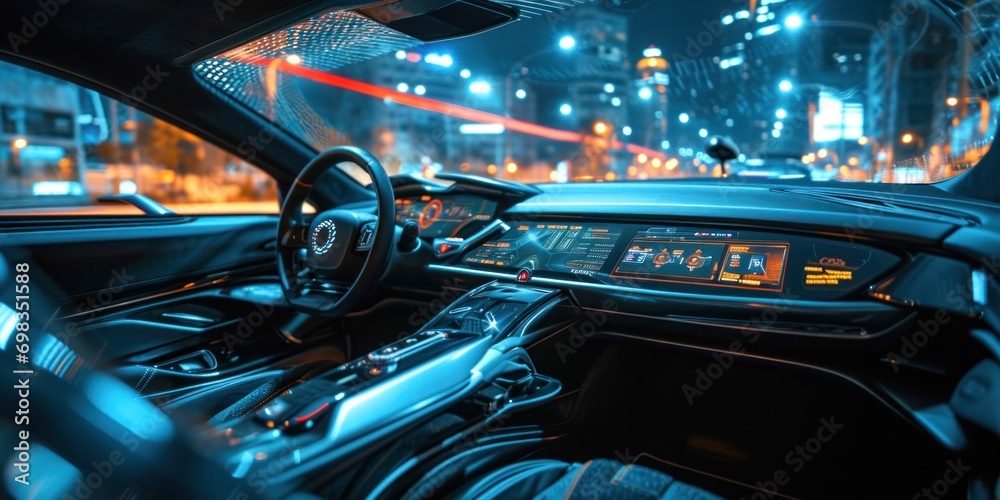
For a century, the dashboard has been the most conservative square footage in the automobile. A speedometer, a fuel gauge, and — more recently — a rectangular touchscreen whose greatest virtue is that it never surprises you. FAW Pentium, the passenger-car marque of China's state-owned First Automobile Works, has looked at that orthodoxy and decided it deserves a small, cheerful revolution. Its newest models leave the factory with a holographic assistant floating above the instrument panel: an anime-styled digital companion with a personality, a wardrobe, and a voice.
The Western headlines duly arrived, somewhere between amusement and mild scandal. "Is that an anime girl on the dashboard?" asked one outlet. Another fixated on the assistant's virtual short skirt. Both reactions rather miss the point. What FAW Pentium has actually done is take a distinctly Chinese pop-culture sensibility and install it, factory-standard, in a midsize sedan.
An Interface Philosophy, Not a Gimmick
To understand why this matters, you have to understand the scale of the culture being exported. *Otaku* fandom in China is not a niche. It is a vast, commercially sophisticated ecosystem of animation, mobile games, virtual idols, and livestreaming, with a generation of consumers who grew up treating two-dimensional characters as genuine companions.
Chinese automakers have spent the past several years competing on screens, chips, and voice recognition. FAW Pentium has chosen to compete on something considerably harder to replicate: emotional attachment. The hologram is not a gimmick bolted onto a spec sheet. It is an interface philosophy — one that assumes the driver would rather be greeted by a familiar character than by a chime and a warning light.
What the Hologram Actually Does
The technical execution is more considered than the tabloid coverage suggests. The assistant is rendered as a holographic projection that appears to float above the dashboard, capable of delivering navigation prompts, weather updates, and vehicle status in a voice and visual style that owners can select. It is, in effect, a virtual passenger — and that framing is deliberate.
Chinese consumers have already embraced virtual idols and AI companions in their phones and smart speakers. The car is simply the next room in the house. By shipping the feature as standard rather than as an optional extra, FAW Pentium signals that this is not an experiment. It is the brand's identity.
The Export That Isn't Sheet Metal
That identity travels. FAW's export ambitions now reach across Southeast Asia, the Middle East, Latin America, and parts of Europe, and the hologram rides along with every unit.
This is where the story becomes genuinely interesting. For years, the global auto industry's cultural traffic has run in one direction: Japanese manufacturers exported *manga* and *anime* aesthetics through everything from kei cars to GT badges, and the world learned to read them. Now a Chinese state-owned manufacturer is doing the same thing with a newer, more participatory form of fandom — one shaped by mobile games and virtual streamers rather than by television syndication. The hologram is not merely a feature. It is a soft-power instrument with a user manual.
Will the West Buy It?
Whether Western buyers will embrace it is an open question. Early coverage in the British and South African press leaned on the novelty and the mild titillation of a "schoolgirl" avatar — a framing that says more about the observers than the observed.
But the underlying proposition is serious. As cars become software platforms, the battle for differentiation will be fought over experience, not horsepower. FAW Pentium has bet that a generation raised on virtual companions will want one in the driver's seat — and that the same instinct exists in Jakarta, Riyadh, and São Paulo as in Shenzhen. It is a remarkably confident wager from a brand most Western drivers have never heard of.
The next time you see a small figure flicker to life above a steering wheel, remember: that is not a gadget. That is an export. And it suggests that the dashboard — that last stronghold of automotive conservatism — may finally be ready to say something about where a car comes from, and who built it for whom.