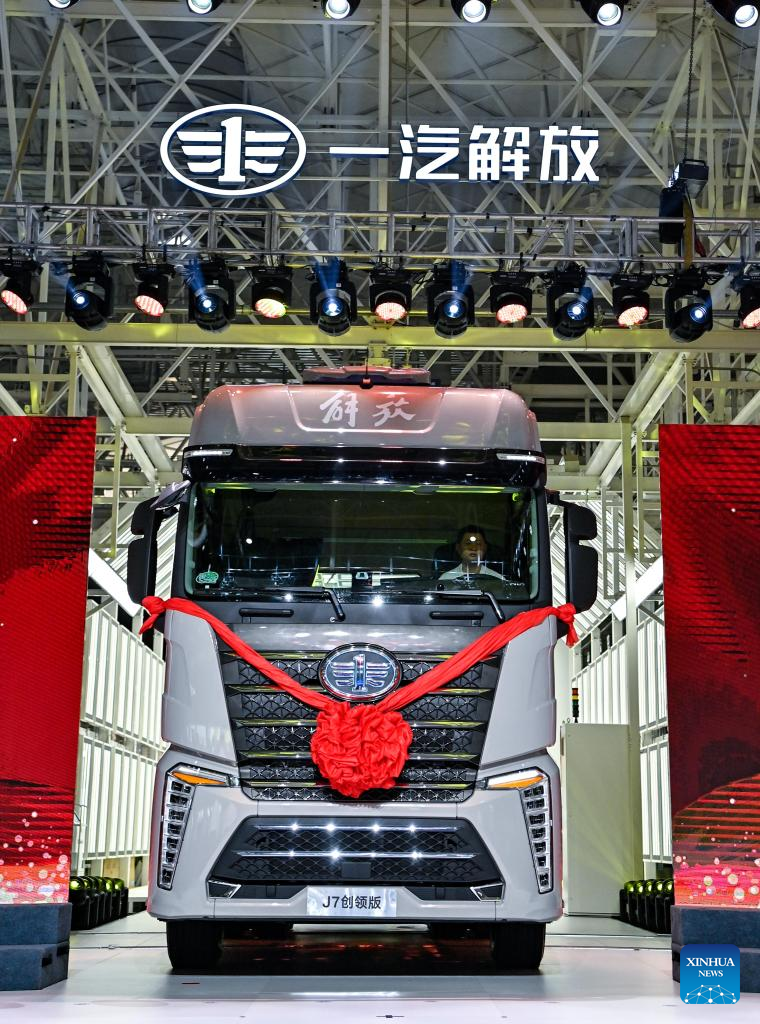
When the world's largest container line formally partners with a truck manufacturer, the trade press files it under logistics and moves on. That's a mistake. The announcement that Maersk has entered a partnership with FAW Jiefang to strengthen the global supply chain for Chinese trucks deserves more attention than it received. On its surface, the agreement reads like a shipping arrangement—a maritime giant agreeing to move vehicles from factory to port. But the substance is more consequential. When Maersk aligns itself with China's leading heavy-truck manufacturer, it is not merely a contract; it is an endorsement. Maersk is betting that FAW Jiefang will become a familiar name on roads far beyond the People's Republic, and it is positioning its own network to carry that ambition across oceans.
The timing is telling. FAW Jiefang has spent the past several years building a technological narrative that no longer depends solely on domestic volume. Its "New Four Modernizations" strategy—electrification, connectivity, intelligence, and sharing—has moved from corporate slideware to production reality. What follows is not a fuel-cell fantasy confined to a laboratory. It is hardware, validated under the kind of punishment that logistics operators actually understand.
Hydrogen by Piston, Cold-Weather Batteries by Sodium
Start with the powertrain. The company's hydrogen combustion engine—a diesel-shaped block burning H2 rather than gasoil—recently passed national certification after a 100,000-kilometre reliability test in a 49-tonne truck. Read that again: a piston engine, not a fuel cell, proven over six figures of distance under load. For fleet managers in Kazakhstan, Chile, or West Africa, that distinction matters. It is familiar mechanical architecture burning a different fuel.
Then there is the battery story. FAW Jiefang has been trialling sodium-ion batteries in heavy trucks, achieving 90 percent capacity retention in extreme cold and charging times of roughly twenty minutes. These are the specifications that decide whether a truck works in a market where charging infrastructure is sparse and winters are unforgiving. Performance, in the commercial-vehicle world, is measured in retained capacity at forty below, not in zero-to-sixty bragging rights.
What Maersk Actually Brings
What Maersk brings to this equation is not technology but reach. The Danish company operates the vessels, terminals, and inland networks that turn a factory in Changchun into a delivered asset in Rotterdam or Lagos. For FAW Jiefang, that means a credible path to export markets that have historically been dominated by European and Japanese incumbents. For Maersk, it means becoming the preferred carrier for a rising tide of Chinese commercial vehicles—a cargo category that is growing as Chinese manufacturers arrive at European truck shows with competitive electric offerings and price advantages that Western OEMs cannot easily match.
The partnership is, in effect, a mutual hedge: FAW Jiefang gains logistics certainty, and Maersk gains a stake in the export wave rather than watching it pass through competitors' hulls.
The Scale Behind the Ambition
The broader context makes this more than a bilateral deal. New-energy heavy trucks topped 50 percent of China's September sales for the first time, a milestone that signals the domestic market is transitioning faster than almost anyone predicted. That scale gives FAW Jiefang the production volume and cost base to compete abroad aggressively.
It has already secured a 3,000-unit hydrogen truck order in a year when global hydrogen heavy-truck sales dipped below 5,000 units—a display of confidence that borders on contrarianism. Add the company's collaboration with Neusoft on AI truck navigation, debuted at IAA, and the picture is of a manufacturer assembling not just vehicles but an ecosystem of software, powertrain diversity, and service capability.
The Hard Part Comes Next
None of this guarantees success. Export markets are protected by tariffs, homologation regimes, and brand loyalty that took decades to build. Chinese passenger-car makers have discovered that going global is slower and more expensive than domestic expansion. But the Maersk partnership suggests FAW Jiefang understands that trucks are not sold like phones; they are sold with warranties, parts networks, and financing. A shipping line that can move vehicles and spares in the same container flow is a quiet but powerful enabler of that aftermarket promise.
The significance, then, is not that a Chinese truck maker signed a logistics deal. It is that the infrastructure of global trade is beginning to reorganise itself around Chinese commercial vehicles as a permanent category rather than a curiosity. FAW Jiefang is testing sodium-ion chemistry, certifying hydrogen combustion, and integrating AI navigation—all while Maersk prepares the ships. The trucks are leaving the laboratory and the domestic highway. The question is no longer whether they will arrive in foreign ports, but whose logos will be on the cranes that unload them.