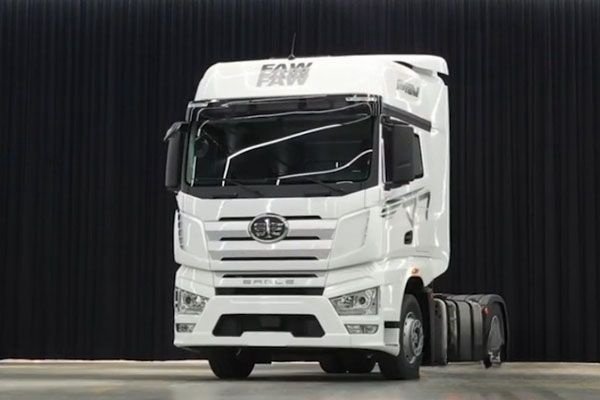
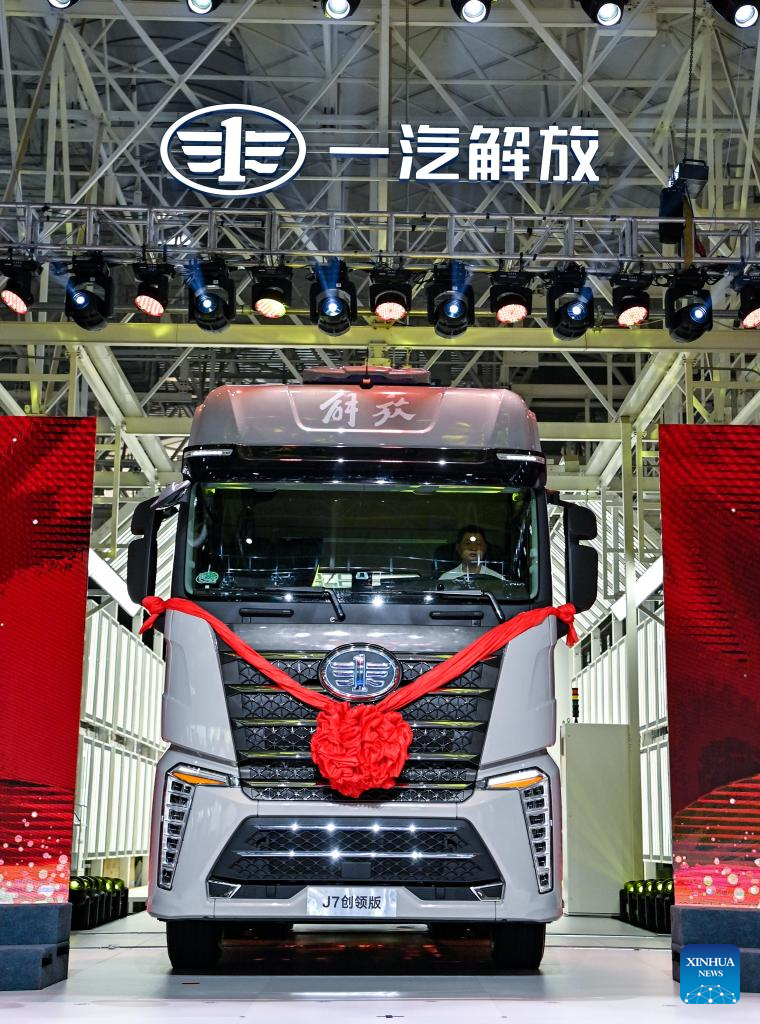
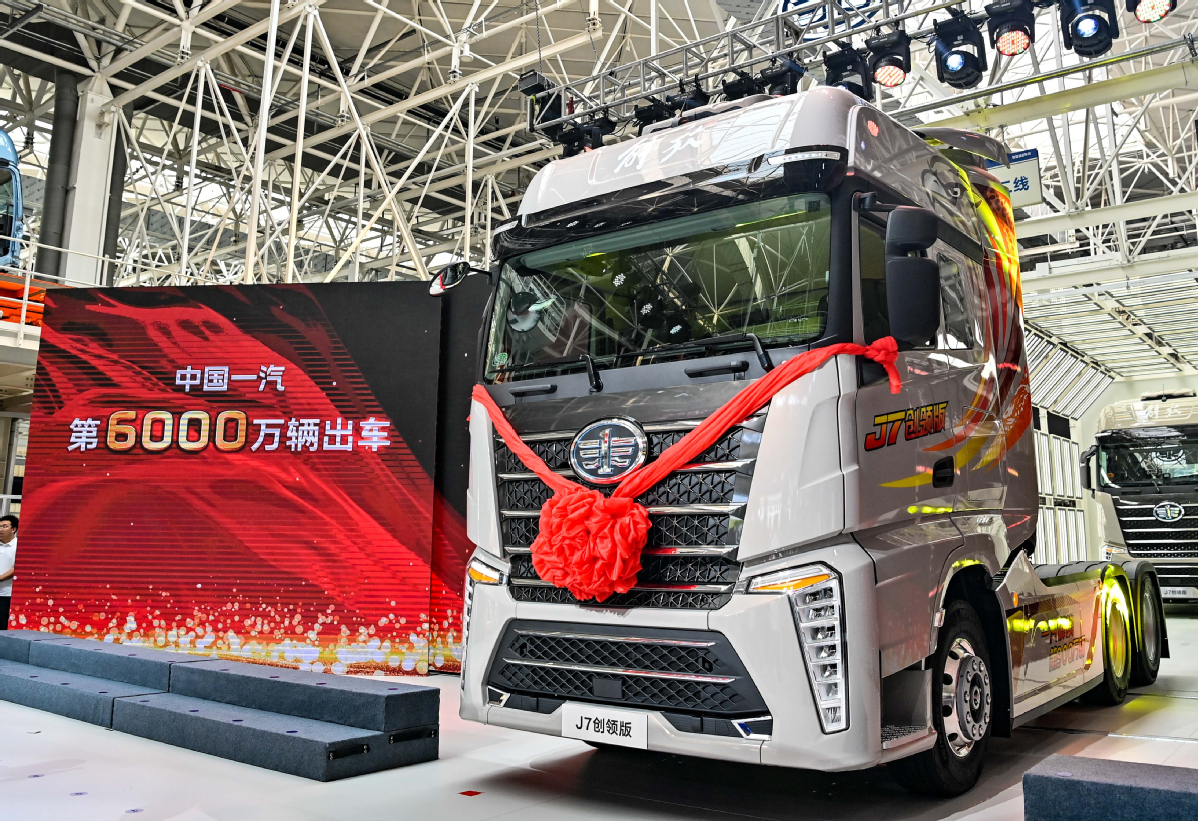
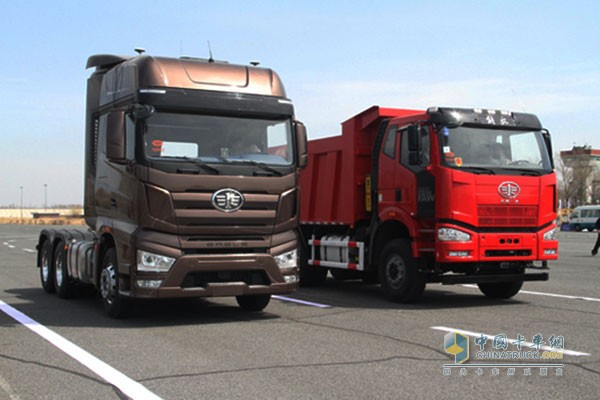
Autonomous trucking has spent years rehearsing on easy ground. The freight corridors of Arizona and Texas, the Beijing–Shanghai expressway—smooth asphalt, clean lane markings, high-definition maps, traffic that mostly behaves. FAW Jiefang has now torn up that script. Through its joint venture with autonomous technology firm Plus, the Chinese commercial vehicle giant has become the first to certify a self-driving truck in China—and the certification is not for a port shuttle or a gated mining loop. It covers the open road, including the unpaved, unmarked, thoroughly unruly dirt stretches that define so much of China's industrial hinterland.
That distinction matters more than the headline. Off-road autonomy is a fundamentally different engineering problem from highway autonomy. Dirt roads lack lane markings, present inconsistent surface friction, and shift their geometry with every rainstorm and every loaded axle. Where a highway system can lean on high-definition mapping and predictable traffic behaviour, an offroad environment demands that the vehicle read the terrain itself. The Plus/FAW Jiefang certification signals that the perception stack, sensor fusion, and fail-safe architecture have matured to the point where Chinese regulators are willing to put their imprimatur on a truck that must make decisions in conditions no map can fully anticipate.
The Hardest Kind of Autonomy
Strip away the press-release gloss and this is a story about edge cases. A paved highway is, from a sensor's point of view, a highly structured environment: consistent geometry, predictable gradients, lane discipline that gives the perception stack something to lock onto. A haul road offers none of that. Dust kicks up and blinds lidar. Ruts and washouts rewrite the drivable surface overnight. A loaded axle changes the terrain beneath the tyres in real time.
Certifying a truck for that world means the vehicle has to read the ground itself rather than trust a map—and it means the fail-safe architecture has to hold up when the environment refuses to cooperate. That regulators signed off is the real milestone here. It suggests the perception and decision-making stack has crossed a threshold from demonstration to dependable.
The New Four Modernizations
It is tempting to treat this as a standalone achievement, but FAW Jiefang's recent news flow reveals a company executing a deliberate, multi-front strategy—one its own leaders have framed as the "New Four Modernizations": electrification, connectivity, intelligence, and sharing. The autonomous certification sits squarely in the intelligence column. The other columns are filling in just as quickly.
The company's hydrogen combustion engine has passed national certification after a 100,000-kilometre reliability test—a genuinely unusual achievement. Rather than a fuel cell, this is a conventional diesel-shaped block burning hydrogen directly, and it has now been validated at the national level in a 49-tonne truck. Meanwhile, FAW Jiefang has concluded long-term trials of sodium-ion battery technology in heavy trucks, with reported capacity retention of roughly 90 percent at minus 40 degrees Fahrenheit and charging times in the region of twenty minutes. For a country whose northern provinces routinely plunge into deep sub-zero winters, a battery chemistry that shrugs off extreme cold is not a laboratory curiosity—it is a commercial necessity.
Redundancy as Strategy
What unites these threads is a philosophy of redundancy. FAW Jiefang is not betting the company on a single powertrain or a single autonomy pathway. It is developing hydrogen combustion, sodium-ion electric, and conventional platforms in parallel, each aimed at the duty cycles and geographies where it makes the most sense.
The autonomous offroad capability then becomes a force multiplier across all of them. A driverless sodium-ion truck hauling ore on a frozen dirt road in Inner Mongolia is a very different proposition from a driverless hydrogen truck on a coastal logistics route, yet both draw on the same certification framework and the same underlying intelligent-driving architecture. That is the quiet cleverness of the strategy: the autonomy stack is platform-agnostic, so every powertrain breakthrough widens the addressable market for the self-driving system, and vice versa.
A Geopolitical Dividend
There is also a dimension the industry would be naive to ignore. China's sodium-ion push, its hydrogen standards countdown, and its autonomous certification regime are all moving in coordinated fashion, with national standards providing the scaffolding that lets companies like FAW Jiefang scale without waiting for market-by-market approval.
The company's global ambitions—an entire industrial ecosystem in tow, as recent coverage of its export strategy suggests—depend on this domestic foundation being solid first. A truck certified to drive itself on Chinese dirt roads is, in effect, a truck certified for the roads of Southeast Asia, Africa, and Latin America, where paved infrastructure is similarly uneven. The certification is not just a technical passport; it is a commercial one.
The romantic image of autonomy has always been the gleaming highway, the hands-off cruise, the driver reading a book at 70 miles per hour. The reality of autonomy's first genuine commercial foothold may look considerably less glamorous: a heavy truck grinding along an unpaved haul road, sensors sweeping the dust, no map to guide it, no lane to follow, and no driver in the cab. FAW Jiefang has just certified that future—and in doing so, it has quietly reframed what autonomy is for. Not the easy miles, but the hard ones. The dirt roads, it turns out, may be where self-driving finally proves it can work.