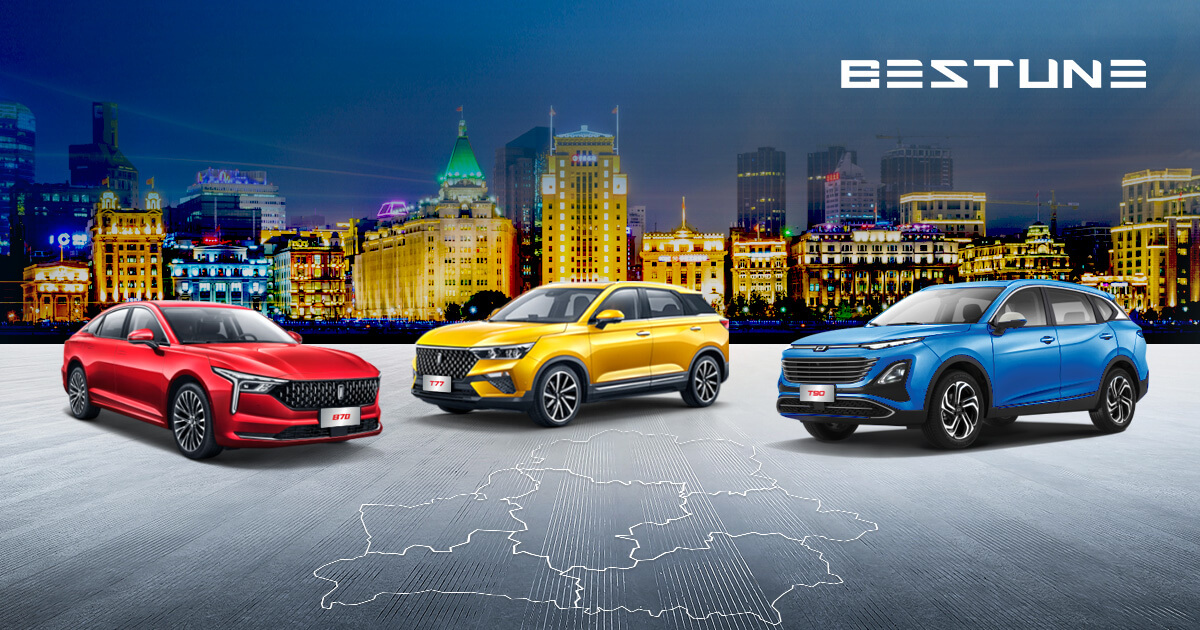
FAW Bestune has never been the loudest voice in China's automotive choir. But listen closely of late, and the volume of activity suggests a brand no longer content with a supporting role. At the centre of this transformation sits a figure that demands attention: 8.55 billion yuan in finalised equity investment — a capital injection that reads less like a routine recapitalisation and more like a mandate.
For a marque that has spent years oscillating between legacy combustion competence and new-energy ambition, the money is the easy part. The harder question is whether Bestune can convert balance-sheet conviction into showroom traction. Its answer, increasingly, is the dual-power sedan.
Two Flavours of Certainty: The Yueyi 08
The clearest expression of that strategy is the Yueyi 08, a B-segment contender launched squarely into the brutally competitive 100,000-yuan bracket. What distinguishes the car is not its price positioning — that territory is crowded beyond reason — but its architecture. The Yueyi 08 arrives with both extended-range electric (EREV) and pure electric powertrains, a deliberate hedge that acknowledges a fragmented Chinese buyer landscape.
Bestune is not betting that range anxiety disappears overnight, nor that charging infrastructure reaches every prefecture at once. Instead, it is selling certainty in two flavours, letting the market decide which one wins. It is a pragmatic piece of product planning, and in a segment this contested, pragmatism may be the sharpest weapon available.
Proof, Not Promise: The Yueyi 07 PHEV
That dual-power logic is not confined to a single model. The Yueyi 07 PHEV has already demonstrated the brand's willingness to compete on hard numbers, with a real-world tested range of 1,754.5 kilometres and a launch price around 13,900 USD. Figures like these are designed to cut through marketing noise; they speak to a customer who wants proof rather than promise.
The pattern is unmistakable. Bestune is constructing a portfolio where electrification is not a halo exercise but a volume proposition, spread across sedans that meet buyers at accessible price points. There is no loss-leader halo car here — just a steady push toward the heart of the market.
Underwriting the Stack: Platform, Cockpit, Software
Yet the 8.55 billion yuan is doing more than funding product launches. It is underwriting an entire technological stack. Bestune has unveiled a new vehicle platform, power system, and smart cockpit — the foundational layer on which the Yueyi family depends.
The D-Life 6.0 cockpit platform, now integrated with the DeepSeek AI large model, signals an intent to compete on software experience rather than hardware alone — a recognition that in the Chinese market, the infotainment system is as much a purchase driver as the powertrain. The strategic partnership with Unity China reinforces this, bringing real-time 3D rendering capability into the cabin at a moment when digital interfaces have become a primary battleground. In cabin experience terms, Bestune is no longer content to follow.
A Pincer Movement: From Pony EV to Yueyi
What makes the gamble genuinely interesting is that Bestune is pursuing it across two frontiers simultaneously. At the entry level, the Pony EV — launched at a startling 4,800 USD — and the Xiaoma, with pre-sales from 4,100 USD, target the urban micro-EV segment with aggressive pricing and manufacturing backed by FAW Group's Yancheng NEV base. At the mid-market, the Yueyi sedans carry the volume ambitions. This is a pincer movement, not a single thrust, and it requires capital depth that only a state-backed parent can provide. The 8.55 billion yuan is what makes the pincer possible.
There are quieter signals too, the kind that reveal how seriously the industrial machinery is being upgraded. Jiangxi Guangwei will produce basalt fibre composite interior parts for the B70, an unconventional materials choice that hints at cost and weight optimisation beyond the obvious. Partnerships with Yueda Group deepen distribution and regional reach. None of these moves generates headlines individually, but together they describe a brand rebuilding its foundations rather than merely refreshing a model line.
The risk, of course, is timing. Chinese EV makers have begun raising prices, yet the South China Morning Post notes that slowing demand could force a reversal. Bestune is committing heavily to a market that may be entering a period of consolidation, where weaker players are squeezed and price discipline collapses. A dual-power sedan strategy is elegant in theory, but it doubles the engineering and certification burden, and it asks consumers to choose between two versions of the same car — a decision that assumes a level of showroom sophistication the brand has not always commanded.
Still, the equity injection changes the calculus. 8.55 billion yuan buys time, and time buys iterations. Bestune's comeback will not be judged by the Yueyi 08's first-quarter sales alone, but by whether the platform, the cockpit, the partnerships, and the dual-power philosophy cohere into something a buyer can recognise and trust. The bet is placed. What remains is the execution — and in China's new-energy market, execution is the only currency that ultimately matters.