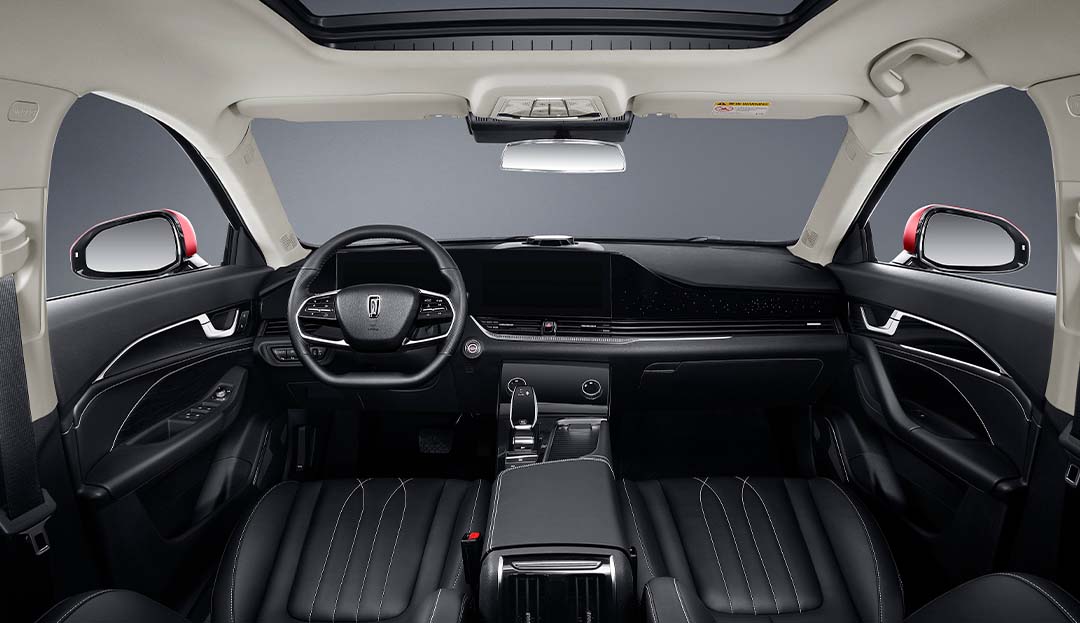
The sustainability conversation in the automotive world tends to start and end at the charging port. Batteries, range figures, kilowatts — that's where the headlines live. But a quieter revolution is unfolding somewhere far less glamorous: the interior panels. And FAW Bestune, the ambitious subsidiary of China's state-owned FAW Group, has just become the first automaker to commit to basalt fiber composite interior components at scale, beginning with the Bestune B70 sedan.
It's a decision that deserves considerably more attention than it's received. Because it signals something bigger than a material swap — a willingness to rethink not merely how a car is powered, but how it is physically constructed.
Rock, Refined
Basalt fiber is exactly what its name suggests: drawn from molten volcanic rock. It shares much of glass fiber's mechanical profile — solid tensile strength, thermal stability, corrosion resistance — but with meaningfully lower embodied energy and no reliance on the energy-intensive silica processing that defines conventional fiberglass. Unlike carbon fiber, which remains prohibitively expensive for mass-market interiors and carries its own considerable production footprint, basalt offers a pragmatic middle path. It's lighter than the steel and dense thermoplastics it replaces, cheaper than carbon, and derived from an abundant, non-toxic raw material.
The news, reported by composites industry outlet JEC, confirms that Jiangxi Guangwei will manufacture basalt fibre composite automotive interior parts for the B70.
For a sedan like the B70, this matters in ways both measurable and philosophical. Every kilogram stripped from an interior panel is a kilogram the powertrain no longer has to motivate, compounding into improved efficiency regardless of whether the engine is a combustion unit or an electrified one.
Why a Sedan, Why Now
The strategic logic runs deeper than weight savings. FAW Bestune is in the midst of an aggressive, expensive transformation. The company recently finalized an equity investment of 8.55 billion yuan and is attempting to pivot comprehensively toward new energy vehicles — a transition that has yielded the Yueyi 08, a B-segment contender with electric suction doors, a liftback tailgate, and dual EREV and pure-electric powertrain options, alongside the remarkably affordable Pony EV, which launches in 2026 from just 4,800 USD.
In that context, basalt fiber is not a vanity project. It's a supply-chain bet.
Consider what the brand is assembling. It has partnered with Unity China on software, integrated DeepSeek's AI large model into its D-Life 6.0 cockpit platform, launched an entirely new vehicle platform and power system architecture, and deepened strategic ties with the Yueda Group. Each of these moves addresses a different dimension of competitiveness — software, intelligence, manufacturing scale, distribution. The basalt fiber initiative addresses materials, the least glamorous but perhaps most durable of competitive advantages.
If Jiangxi Guangwei can deliver these composite parts at volume and at cost, Bestune gains a proprietary interior material story that no competitor can replicate overnight. Sustainable materials become a brand differentiator rather than a compliance obligation.
The Tactile Gamble
There is, of course, a gamble embedded here. Basalt fiber composites have existed for decades, but their adoption in high-volume passenger vehicles has been sporadic and cautious. Manufacturing consistency, surface finish quality, and long-term durability under the thermal and UV stresses of a real cabin remain engineering questions that Bestune and its supplier must answer convincingly.
A sedan interior is a tactile, visible product. Customers will judge these panels with their fingertips, not with a life-cycle assessment. If the material reads as cheap or wears poorly, the sustainability narrative collapses under consumer skepticism — and no amount of embodied-energy savings will rescue it.
Competing on More Than Price
Yet the broader trajectory of FAW Bestune suggests a company willing to place several such bets simultaneously. The Yueyi 07 PHEV claimed a real-world tested range of 1,754.5 kilometres and launched at 13,900 USD. The Pony is chasing the entry-level electric market with genuine aggression. The Yueyi 08 is arriving into China's fiercely contested 100,000-yuan B-segment at a moment when NEV wholesale volumes are climbing toward 1.57 million units monthly.
Against that backdrop, basalt fiber is less a novelty than a statement of intent: that Bestune intends to compete on more than price and range alone.
The industry should watch the B70 closely. If basalt fiber interiors prove viable at scale, Bestune will have demonstrated that sustainable materials can be a mainstream engineering choice rather than a premium flourish — and that the most consequential innovations in a car are sometimes the ones you can touch but never see. That, more than any single model, is the philosophy worth tracking.


