:quality(80)/p7i.vogel.de/wcms/e5/db/e5db0e76bc7a8b4dcb67f74c105a0891/0107143839.jpeg)
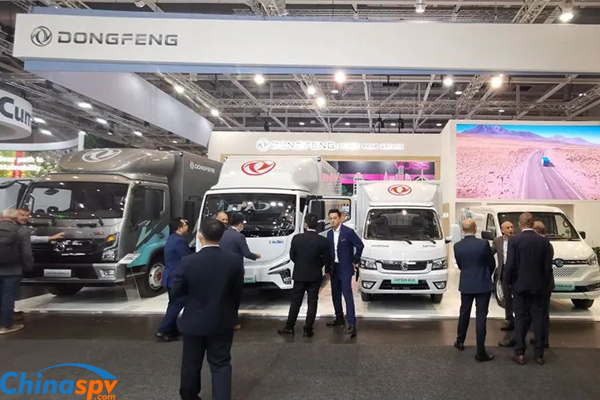
At IAA TRANSPORTATION in Hannover, the assembled commercial vehicle and mobility press expected the usual procession: battery-electric concept after battery-electric concept, each one promising another incremental gain in range and charge rate. Dongfeng Motor had other ideas. The Chinese state-owned giant arrived with a zero-carbon plan and three hydrogen-powered vehicles built on its new T1 platform — a trio that signals a technological path most of its domestic rivals have quietly abandoned.
While BYD, Nio, and Li Auto pour billions into lithium-ion supply chains and battery-swap networks, Dongfeng has been hedging a parallel bet on hydrogen. Now it is putting that bet on the road in Europe, not merely on a Chinese test track.
Optionality Over Dogma
Hydrogen fuel-cell passenger cars have struggled everywhere. The Toyota Mirai and Hyundai Nexo remain niche offerings, hemmed in by sparse refuelling infrastructure and the brutal efficiency math that favours batteries in light vehicles. Dongfeng knows this. Yet the decision to showcase hydrogen vehicles on the T1 platform in Hannover — a platform engineered to accommodate multiple powertrains — reveals a strategy rooted in optionality rather than dogma.
The company is not betting the house on fuel cells. It is ensuring that when the regulatory or infrastructure calculus shifts, it already owns the engineering. For a manufacturer of Dongfeng's scale, optionality is not indecision. It is insurance.
A Credential, Not Just a Product Launch
The timing of this hydrogen push is inseparable from Dongfeng's wider international manoeuvring. The company is preparing to sell EVs in Canada, reportedly via a reduced tariff quota, and is deepening ties with Stellantis through a planned European distribution and production joint venture — with reports suggesting Dongfeng could build cars at Stellantis' French plant. Add the confirmed arrangement to supply batteries for Jeep's new Chinese EVs, and a picture emerges: a company embedding itself into Western industrial ecosystems through component supply and contract manufacturing before its own badge ever appears on a European forecourt.
Hydrogen sedans, in this context, are less a product launch than a credential — proof that Dongfeng competes at the technological frontier, not merely on price.
The Dual-Track Balance Sheet
There is a domestic logic at work too. Dongfeng's VOYAH brand is set to become the group's core listed entity following a privatisation and delisting, a restructuring that concentrates its premium electric ambitions into a single vehicle. Meanwhile, the Dongfeng-Huawei venture brand Epicland has launched the X9, targeting the large extended-range SUV segment.
These moves show a company reorganising itself around electrification while simultaneously funding a hydrogen programme that may not pay off for a decade. Few rivals possess both the balance-sheet depth and the state backing to sustain that dual track.
The Patience Hydrogen Requires
The Wuhan Open tennis sponsorship that once defined Dongfeng's international visibility is a reminder of how long the company has been building brand recognition abroad — and how patient its capital is. That patience is precisely what hydrogen demands. Where a startup must chase quarterly delivery numbers, Dongfeng can absorb a slow ramp, iterate on the T1 platform, and wait for European regulators to decide whether green hydrogen belongs in the passenger-car conversation at all.
Whether hydrogen sedans become Dongfeng's defining export or a costly footnote will depend on forces far beyond Wuhan: electrolyser costs, EU energy policy, and the willingness of governments to fund refuelling networks that batteries do not need. But the strategic logic is difficult to dismiss. In a market where every major Chinese manufacturer is converging on the same battery-electric playbook, Dongfeng has chosen to compete on a different axis — one its rivals are conspicuously not making. That alone makes the T1 platform worth watching. The zero-carbon future may be electric, but Dongfeng is betting it will not be electric only.