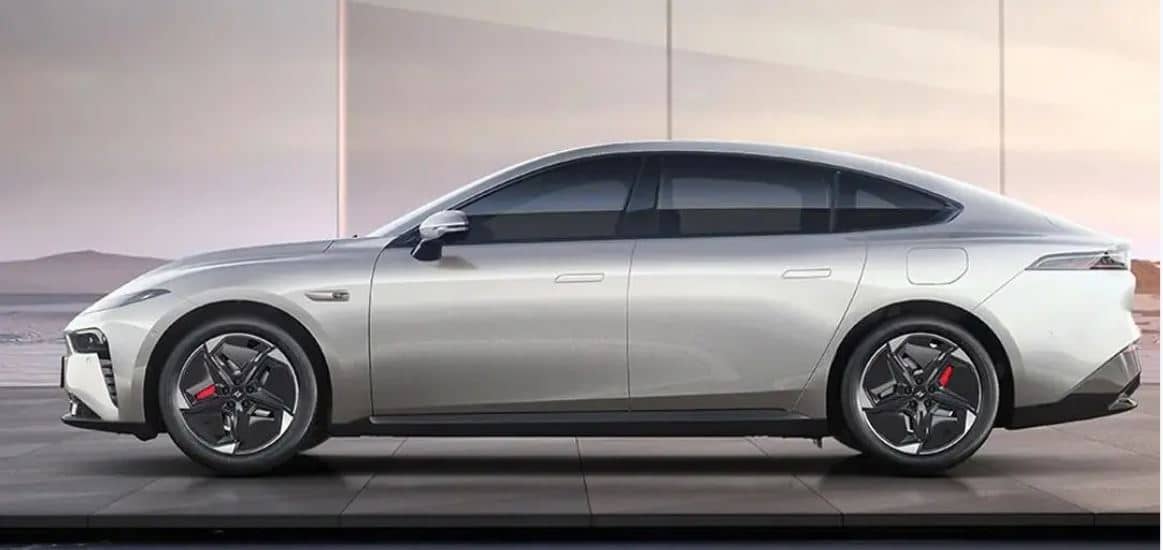
Battery swapping has long been the EV world’s most tantalizing paradox—a technology that promises petrol-grade refueling convenience, yet remains shackled to a single brand’s walled garden. NIO has championed it with religious fervor, but its proprietary network has always felt like an exclusive club with a strict door policy. Now, a quiet regulatory filing from Chinese state-owned giant Dongfeng Motor is threatening to blow the gates wide open. The sedan in question, recently surfaced in China’s Ministry of Industry and Information Technology filings, isn’t notable for its sheet metal or silhouette. It’s the battery architecture underneath that matters: this car is engineered specifically for CATL’s standardized swappable packs—the same units powering the battery giant’s rapidly expanding EVOGO network.
This isn’t just another electric sedan in a market drowning in them. It’s the first tangible proof that CATL’s ecosystem is reaching the OEM adoption critical mass needed to make swapping a practical, cross-brand reality. Dongfeng isn’t jealously guarding a proprietary pack design; it’s building around a shared, interoperable standard. The implications are immediate: a Dongfeng owner could theoretically roll into a station designed for a different brand’s CATL-compatible car, swap a depleted unit for a fresh one in under three minutes, and be gone before a Tesla finishes plugging in. Range anxiety and 30-minute fast-charging sessions suddenly feel like relics of a less elegant era.
A Pragmatic Bet on Infrastructure Over Chemistry
The timing is impeccable. Dongfeng isn’t approaching this from a position of desperation but from a wave of technological momentum. The company has been publicly aggressive on multiple battery fronts, recently revealing plans to mass-produce next-generation solid-state batteries in the second half of this year and teasing an in-house hybrid solid-liquid unit for October. Yet the decision to also embrace CATL’s swapping standard reveals a mature, clear-eyed understanding of the market: not every customer needs bleeding-edge solid-state density, but every customer needs convenient energy replenishment.
By hedging across both chemistry and infrastructure, Dongfeng is positioning itself as the everyman’s EV maker—offering cutting-edge tech for the enthusiasts and accessible, practical swapping for the masses. It’s a dual-pronged strategy that acknowledges a fundamental truth: the best battery is the one you don’t have to wait for.
This filing also arrives amid a significant corporate restructuring. Dongfeng is streamlining operations, with its premium VOYAH brand taking over as the core listed entity following a privatization move. Consolidating resources under a single, focused umbrella allows for more aggressive, unified product planning. The new swapping sedan—likely positioned under the mainstream eπ or Nammi sub-brands—fits neatly into this streamlined vision. It’s a volume play, designed not to dazzle with autonomous driving gimmicks but to solve the fundamental logistics of urban EV ownership.
The European Dimension That Changes Everything
Here’s where the strategic brilliance extends beyond China’s borders. Dongfeng is simultaneously forging a €1 billion joint venture with Stellantis to produce and potentially export vehicles from a French plant. If that European venture were to adopt the same CATL-compatible swapping architecture, the implications become genuinely global.
CATL has already established swapping stations in Europe. A Dongfeng-built, Stellantis-distributed vehicle tapping into that network would introduce the concept to a Western audience that has largely dismissed it as a Chinese curiosity. More importantly, it would offer a compelling answer to Europe’s charging infrastructure woes—where grid capacity constraints and permitting delays continually hobble fast-charging corridor expansion. Swapping doesn’t require massive grid upgrades at every location; it requires centralized battery storage and a robotic arm.
Why This Could Finally Crack the Code
Critics will rightly point out that swapping demands massive capital expenditure for battery inventory and that full industry standardization remains a distant dream. But Dongfeng’s filing proves the dream is at least viable. When a state-owned automotive giant with Dongfeng’s scale decides to bet on a shared standard rather than a proprietary one, it sends a signal across the industry: the infrastructure cost is worth sharing.
The sedan may be the headline, but the real story is the quiet, deliberate construction of a unified energy ecosystem. Dongfeng isn’t just launching a car; it’s launching a concept—one where the battery is no longer a burden of ownership but a utility service, as interchangeable as a propane tank. It’s a philosophy that prioritizes the mundane but crucial act of refueling over the vanity of proprietary tech. And if this sedan reaches the market with the expected pricing, and the EVOGO network continues its expansion, the era of the swappable sedan will have finally arrived. For a company often seen as a follower in the EV race, Dongfeng might just have leapfrogged the entire field with the simplest idea of all: making the battery a communal resource, not a competitive weapon.