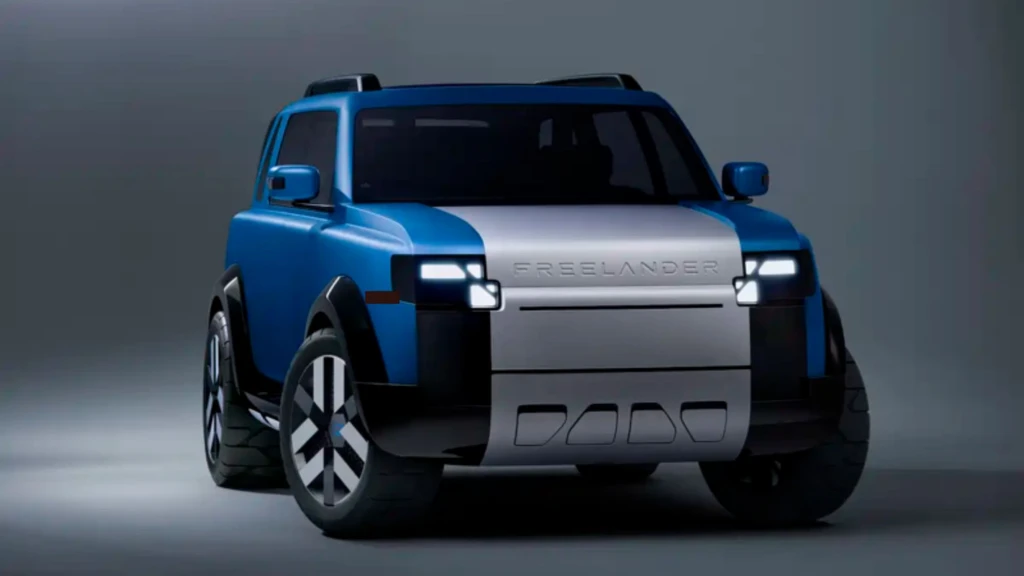
Reviving a dormant nameplate is never a neutral act. When Chery Jaguar Land Rover chose Abu Dhabi for the international debut of the Freelander 8, it was making a statement that carried well beyond the Gulf. Here was a vehicle engineered in China, built at the Changshu plant, wearing a badge that once belonged to muddy boots and country lanes across Britain — now presented in a city of glass towers and twelve-lane boulevards. The symbolism was almost too neat to ignore.
The Freelander name carries genuine weight. It was the compact SUV that, in the late 1990s, helped democratise the Land Rover brand for a generation of families who wanted the silhouette without the agricultural running costs. Its retirement left a gap. Now, under the stewardship of the Chery Jaguar Land Rover joint venture, that name has been resurrected and repositioned — not as a nostalgic throwback but as a forward-facing, technology-dense proposition aimed squarely at export markets.
The Machine: Big Screen, Big Numbers
The Freelander 8 itself is a large five-seater SUV that starts at RMB 289,900 in China, where deliveries began on October 31. Its interior is dominated by a 46.3-inch 8K panoramic display spanning the dashboard — cabin architecture that owes rather more to Shenzhen than to Solihull. Powertrain figures quoted for the range-topping variant include output of up to 617 horsepower and a claimed range approaching 550 miles, numbers that place it firmly in the premium electric conversation. Mass production at Changshu is already underway, and pre-sales opened in August, suggesting a venture moving with deliberate speed.
Why Abu Dhabi, and Why First
What makes the Abu Dhabi launch significant is not the vehicle alone but the strategy it reveals. Chery Jaguar Land Rover has been explicit that it wants roughly half of Freelander sales to come from outside China. Launching abroad first — or at least prominently — signals that this is not a domestic-only play designed to absorb excess capacity. The Gulf is a sensible beachhead: it rewards scale, tolerates bold design, and has an appetite for premium SUVs that rivals almost any region on earth. From there, the roadmap points toward broader global markets.
The Branding Question
The branding question remains the most interesting one. The Freelander is being positioned as a distinct marque under the Chery Jaguar Land Rover umbrella, borrowing heritage without fully claiming it. Recent commentary from the Chinese side has suggested Chery wants to "become British" through a deeper partnership with Jaguar Land Rover — a phrase that invites scrutiny. Does it mean deeper technical collaboration, shared platforms, or a more thorough absorption of British design language and brand equity? The Freelander 8 offers a partial answer: British heritage as a stylistic and emotional wrapper, Chinese engineering and manufacturing as the substance beneath.
The Direction of Travel
There is a certain irony in the direction of travel. For decades, the flow of automotive influence ran from West to East — joint ventures in China built local versions of foreign models. The Freelander 8 inverts that logic. A Chinese-developed electric SUV now wears a British badge and is launched in the Gulf with ambitions of selling across continents. The Changshu factory is not a satellite assembly operation but the wellspring of a global product.
Whether buyers in Abu Dhabi, and eventually in Europe and beyond, will accept this arrangement is the open question. Heritage is a powerful marketing asset, but it is also fragile; it survives only if the product feels worthy of it. On paper, the Freelander 8 has the specification to compete. The 46.3-inch display, the headline power figures, the premium positioning — all suggest a vehicle designed to be taken seriously rather than dismissed as a badge-engineering exercise.
The Abu Dhabi debut, then, is best read as a declaration of intent. Chery Jaguar Land Rover is telling the market that the Freelander is back, that it is global in ambition, and that the marriage of Chinese capability and British identity is not a compromise but a proposition. The nameplate that once sold Britain to the world is now being asked to sell a new kind of Britishness — one assembled in Jiangsu, launched in the Emirates, and aimed at everywhere in between.