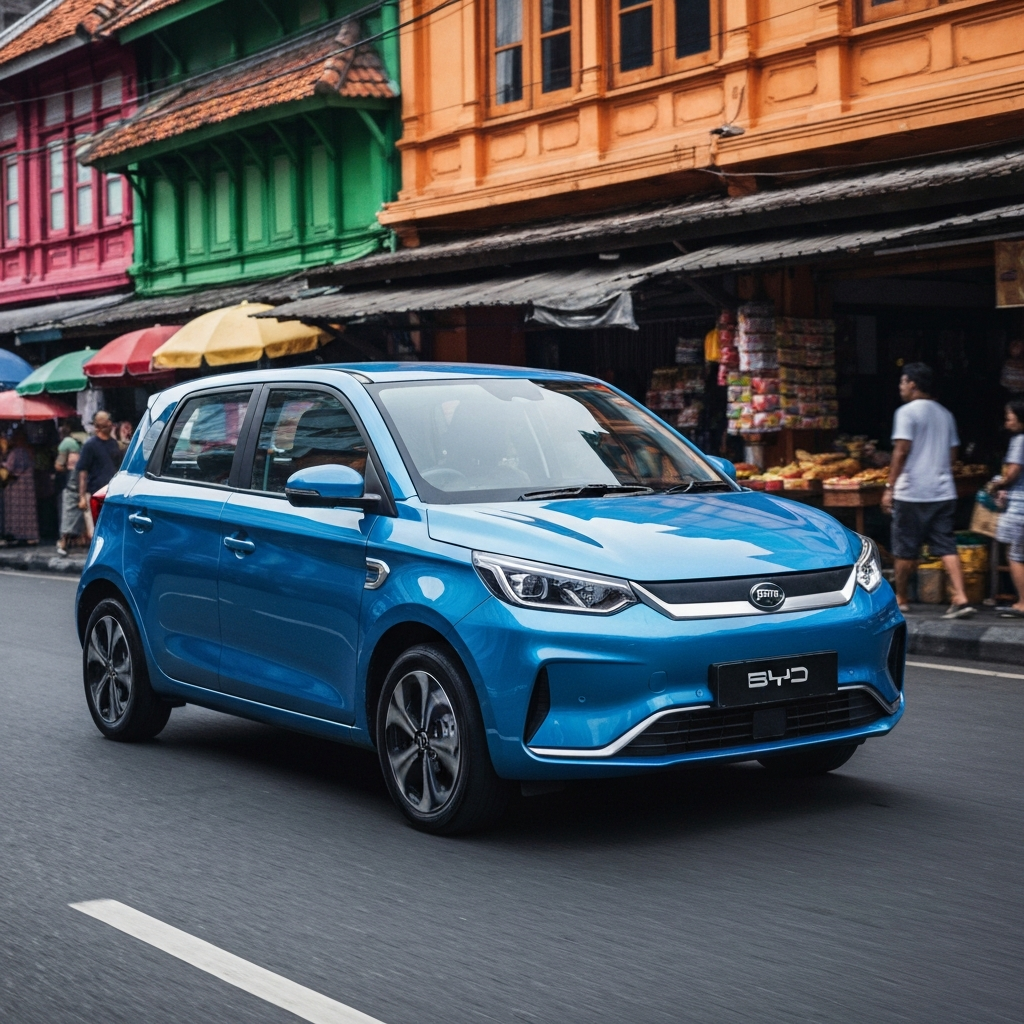
The most consequential EV announcement of the year isn't coming from a six-figure flagship or a hypercar built to humble European exotics. It's coming from the entry-level hatchback segment, where BYD has quietly pulled off an act of technological levelling that the rest of the industry will spend years trying to match. The second-generation Seagull, launched in China from roughly $9,810, now carries Flash Charging — the same headline technology the company has been rolling out across its premium lineup. In one move, BYD has redrawn the boundaries of what a budget EV can be.
Think about what that means in plain terms. For less than the price of a well-optioned combustion city car, Chinese buyers can now access a machine that adds meaningful range in the time it takes to order and collect a coffee. BYD's Flash Charging architecture, marketed aggressively on the Denza and Yangwang sub-brands, has until now been the preserve of vehicles costing several times as much. Trickling it down to the Seagull isn't merely a product update — it's a statement of intent about where the company believes the mass market is heading. The second-generation car is also larger than the model it replaces, addressing the most common criticism of the original: that its footprint was too compromised for anything beyond dense urban use.
The Vertical Integration Playbook
The strategic logic is characteristically shrewd. BYD has built its global ascent on vertical integration — batteries, semiconductors, motors and charging hardware all developed in-house. That allows the company to push expensive technology downmarket faster than rivals who must buy components on the open market. Where a legacy manufacturer might reserve fast-charging capability for premium trims to protect margins, BYD treats it as a volume proposition. The result is a sub-$10,000 car that undercuts almost every competitor on price while offering a charging experience many mid-market EVs in Europe and North America still can't match.
A Warning Shot for Western Rivals
That disparity is becoming difficult for Western manufacturers to ignore. The Seagull's new capability lands at a moment when Chinese EVs are gaining genuine traction in Europe, with buyers increasingly comparing BYD products favourably against established rivals — including Tesla. The company's ambitions are not confined to its home market: it is studying plans for a factory in France, has launched Flash Charging in Indonesia alongside Denza models, and continues to play what the *Financial Times* characterised as a patient long game in Japan. Each of these moves is underwritten by the same advantage — the ability to offer more technology at a lower price point than almost anyone else.
From Halo Cars to Hatchbacks
Nor is the Seagull an isolated curiosity. The breadth of BYD's current offensive is striking: a high-tech five-seat SUV with 690 hp and dual 30-inch screens, the 1,180 hp Yangwang U8 that can float and is edging toward an Australian launch, and a Shark 6 ute that has been lining up against the Ford Ranger Raptor in drag races. At the opposite end of the spectrum sits the Seagull, and the fact that the same company can credibly sell both is precisely the point. Technology developed for halo products — charging speed, battery chemistry, thermal management — cascades down the range, and the entry-level car benefits.
What It Means for Buyers — and the Competition
For consumers, the message is bracing. The assumption that affordable electric motoring must involve compromise on charging is being dismantled by a company with the scale and integration to make fast charging a commodity rather than a luxury. For competitors, the Seagull is a warning shot. If BYD can put Flash Charging in a car that costs less than $10,000 in its home market, the question is no longer whether the technology will reach Western showrooms at an accessible price — but how quickly, and who will be left explaining why their cheapest EV still takes an hour to recharge.
Strip away the sales charts and the factory announcements, and what remains is a clear automotive philosophy: technology should earn its place by reaching the most buyers, not the wealthiest ones. BYD has spent years building the industrial muscle to make that idea real. With the Seagull, it has finally put it on four wheels — and the rest of the industry is now chasing a hatchback.


