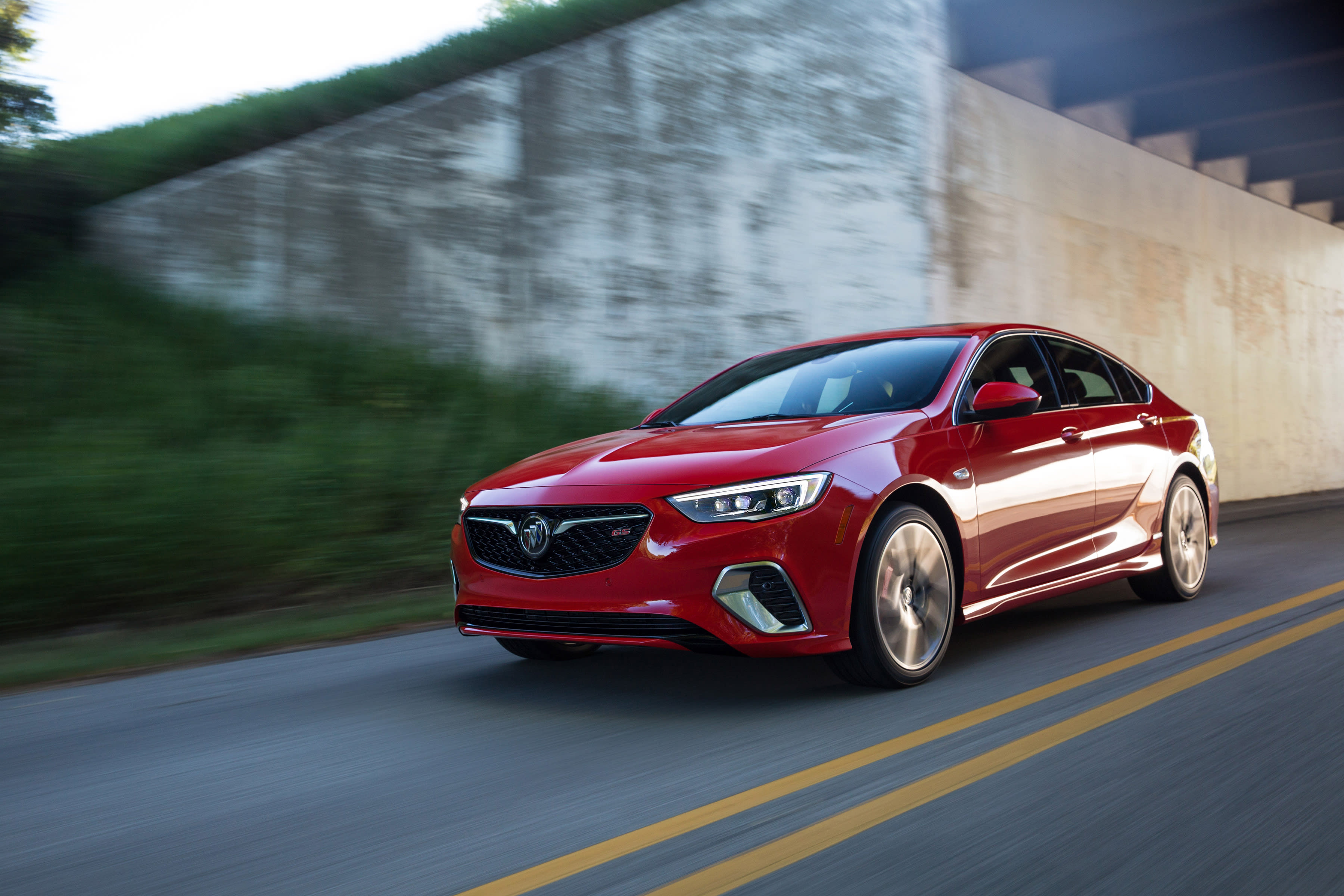
There's a special kind of heartbreak reserved for the great car that simply never found its people. No recall notice, no farewell press release—just a quiet slide into obscurity. Buick knows this story intimately. The brand that once unleashed the GNX, a machine so fearsome it became folklore, spent its twilight years building sedans. And in that stretch, it built something that by every objective measure deserved a cult following: the Regal GS, the last true sports sedan to wear the tri-shield.
Consider what Buick actually assembled here. A 310-horsepower V6. Standard all-wheel drive. A twin-clutch torque-vectoring rear differential. All of it wrapped in a package costing roughly half what Volkswagen asked for a comparably equipped Golf R. And almost nobody bought one. That fact should sting anyone who cares about driving, because the Regal GS wasn't a cynical badge-and-bodykit exercise—it was the real thing, hiding in plain sight.
German Bones, American Muscle
To appreciate what was lost, start underneath. The Regal GS rode on a German-engineered platform shared with the Opel Insignia, and Buick's engineers made the most of that foundation. The 3.6-liter LGX V6 routed its power through a nine-speed automatic, while the chassis was tuned for genuine composure rather than mere pillow-soft comfort. This was a sedan that took its driving duties seriously.
The centerpiece, though, was the torque-vectoring rear axle—the same fundamental idea that makes the Golf R feel so improbably agile. By shuffling power left and right across the rear axle, the system rotated the car through corners with a fluency that belied its size. Add Brembo brakes, adaptive dampers, and seats that actually held you in place through a quick sequence of bends, and you had a machine capable of embarrassing far more expensive hardware on a good back road. That's not marketing copy—that's the mechanical truth of the thing.
The Bargain That Should Have Been a Phenomenon
The value proposition was almost absurd. A loaded Regal GS stickered in the low-to-mid forties. A Golf R with comparable equipment pushed toward fifty and beyond once dealers finished with their markups. On paper, the Buick was the smarter buy by a wide margin. In practice, the Volkswagen became the enthusiast's default answer while the Buick became a footnote.
The reasons are instructive. Buick's showrooms were populated by crossovers and staffed for comfort, not cornering. The brand's marketing never once acknowledged that the GS existed. And the badge on the grille carried none of the cultural cachet Volkswagen had spent decades cultivating. Buyers who wanted a fast sedan simply never thought to look. The car didn't fail on merit—it failed on visibility. Enthusiasts walked past it on their way to something else, and the Regal GS slipped into the shadows without a fight.
Obscurity Has Its Perks
That indifference carries a silver lining for anyone paying attention now. Depreciation has been characteristically brutal on the Regal GS, which means clean, low-mileage examples trade for a fraction of their original MSRP. We're talking genuine performance hardware—torque vectoring, Brembos, adaptive dampers—at used-economy-car money. It is, quietly, one of the great overlooked bargains in modern enthusiast motoring, a car whose obscurity is precisely what makes it attractive. The few who know, know.
There's a certain irony in watching Buick's current news cycle. The headlines are dominated by paint color changes for the 2027 Envista, lease-friendly equipment groups for the Enclave, and the brand's sponsorship of the LPGA Shanghai, where Ruoning Yin recently took home the trophy and a share of a $3.2 million purse. Meanwhile, the collector market continues to chase the 1987 Grand National and the GNX into six-figure territory—reminders that Buick's performance heritage is valued most when it is safely in the past.
The Regal GS sits squarely in that same lineage: a final, honest attempt at a driver's car from a brand that had all but stopped trying. It carried the torch the GNX lit, even if nobody showed up to watch. And for the handful who did notice—who climbed in, thumbed the starter, and felt that V6 settle into its idle before pointing the nose at a favorite road—that's exactly the point. Buick's finest performance sedans have always been the ones you had to discover for yourself. The Regal GS just made the discovery a little quieter, and the reward a lot cheaper.


