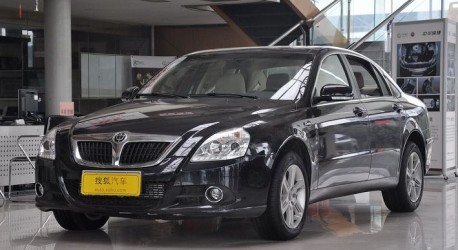
In 2007, a modest four-door sedan rolled out of Shenyang and into the history books as the first Chinese car exported to Europe in meaningful volume. The Brilliance BS6 was never a great car — it was no "Dawn of the Chinese Car" — but it was a historic one. It marked the moment a Chinese manufacturer dared to sell a mid-size sedan on German soil, and it remains the purest symbol of Brilliance Auto's rise and fall. Today, that same company is a zombie brand: production qualifications frozen, debt restructuring a cautionary tale, its very existence a footnote to BMW's China story.
The BS6 — sold in some markets as the Brilliance M1 — arrived with a 2.4-litre four-cylinder engine, a five-speed manual, and styling that owed more to the previous century than the one it was entering. European crash testers were unkind; the car's Euro NCAP performance became a small scandal, and its sales never exceeded a rounding error. Yet for a moment, Brilliance stood as the vanguard of Chinese automotive ambition. It was exporting to Europe years before BYD or Geely had meaningful international plans. That achievement deserves its place in the record, even if the car itself does not.
The Vanguard That Couldn't Hold
What followed was a slow unravelling. Brilliance's fortunes became increasingly tied to its joint venture with BMW, which built sedans in Shenyang and generated the profits that kept the parent company afloat. When BMW paid $4.2 billion to take a controlling stake in the joint venture in 2022, Brilliance's shares sank 30 per cent in a single session. The message was unmistakable: the Chinese partner had become a passenger in its own most valuable asset. Reports that Brilliance wanted out of the BMW joint venture only deepened the sense of a company thrashing for survival.
The Unravelling
The news since has been uniformly grim. Brilliance Auto's debt problems drove it into restructuring; bond defaults triggered lawsuits over $457 million; and its joint venture with Renault filed for bankruptcy in China. The city of Shenyang has weighed a takeover of Brilliance's major owner, and Chinese regulators have moved decisively against the industry's walking dead. As Gasgoo and 36Kr have reported, the production qualifications of eight established automakers have been permanently frozen — part of a broader elimination race in which state intervention is ending the lingering of zombie automotive brands. Brilliance is squarely in that category: an entity that still technically exists, still technically owns assets, but no longer builds anything the market wants.
A Bitter Symmetry
There is a bitter symmetry to the story. The BS6 was Brilliance's attempt to prove that a Chinese company could compete in Europe on engineering terms. Two decades later, European carmakers are the ones fuelling Chinese innovation — as the MERICS research argues — while Brilliance's legacy has been reduced to a line item in BMW's control strategy. The company that once shipped sedans to Germany now cannot ship much of anything.
The BS6 itself is a curious artefact for collectors and historians of the industry: a car that was never good, but was first. It carried the hopes of an entire national strategy on its indifferent shoulders and proved, at least, that the ambition existed. That Brilliance could not sustain the ambition is a story about capital, joint-venture dependency, and the brutal economics of scale in a market that now builds better cars than almost anyone. The zombie does not mourn its own passing. But those who remember the BS6 arriving in European showrooms should note what it represented — and what its parent company's long, quiet collapse has cost.