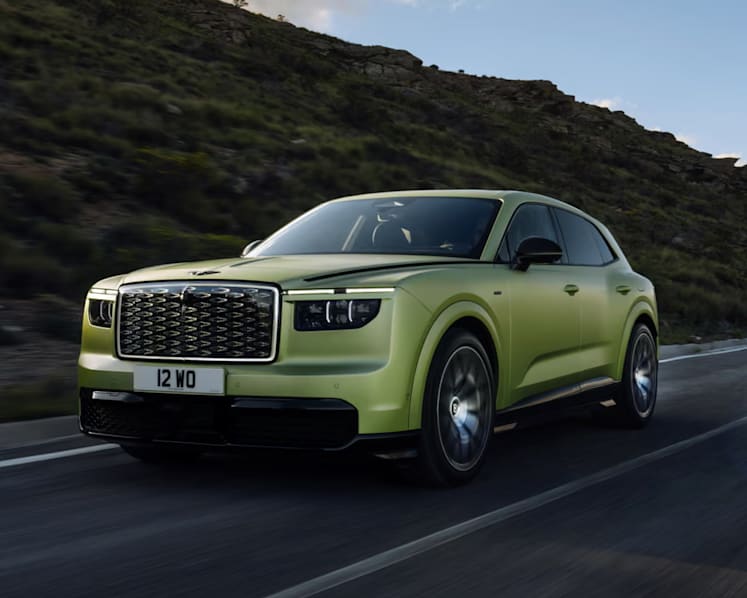
The headlines wrote themselves the moment Bentley confirmed its first electric vehicle would synthesise engine noise through its cabin speakers. A grand old marque, guardian of the twin-turbo W12 and the theatrical V8 rumble, apparently reduced to piping an orchestral growl through the audio system. Purists clutched their flat caps. Comment sections filled with lamentations about authenticity. And somewhere in the noise, a far more consequential number went almost unnoticed: 621,000 miles.
That is the distance Bentley's engineers have accumulated in testing the Torcal, the Crewe marque's first fully electric SUV and the most powerful Flying B ever built. It is a figure that deserves considerably more attention than a debate over whether a synthesised powertrain note constitutes a betrayal of tradition. Because while the world argued about what a Bentley should sound like, Bentley was quietly answering the only question that truly determines whether the Torcal succeeds: whether an electric Bentley can be a Bentley in every way that counts.
Twenty-Five Times Around the Equator
Consider what 621,000 miles represents. That is roughly twenty-five times around the equator, or the equivalent of a decade and a half of hard motoring compressed into a development programme. It is the kind of durability validation that separates a serious luxury proposition from a compliance exercise. Bentley's clientele do not merely drive their cars; they cross continents in them, they keep them for years, they expect the mechanical integrity of a grand tourer to hold from the Cotswolds to the Côte d'Azur and back. The wealthy buyers Reuters notes are being courted so carefully will not tolerate a flagship that falters. Bentley knows this, and the mileage figure is its argument.
The Unglamorous Work
It is also, quietly, a statement about engineering vanity. Anyone can bolt a large battery to a handsome body and call it a flagship. The difficult, expensive, unglamorous work lies in thermal management under sustained load, in the degradation of cells across hundreds of thousands of miles, in the structural fatigue of a two-and-a-half-tonne vehicle repeatedly stressed at speed. Bentley has subjected the Torcal to the same punishing regime it applies to its combustion cars, and it has done so while promising the most powerful Flying B ever built. Power is easy to advertise; durability is hard to earn.
Decoration, Not Substance
The orchestral engine sound, by contrast, is a detail of presentation rather than substance. It is, in fairness, a defensible one. Bentley has spent a century cultivating a sensory signature, and silence at full throttle is a genuine break from that inheritance. A synthesised note, carefully calibrated, may well serve as a graceful bridge between the old world and the new. But it is decoration. It will neither win nor lose a single sale among buyers who understand that the Torcal rises or falls on whether it feels indestructible at year ten.
The Real Test of an Electric Luxury Car
There is a broader industry lesson buried in the coverage. The transition to electric propulsion has been accompanied by endless chatter about what is lost — the noise, the character, the mechanical theatre. Far less attention is paid to the engineering that must be gained. Bentley's 621,000-mile programme is a reminder that the real test of any electric luxury car is not its soundtrack but its stamina. The Torcal will be judged in the cold of a continental winter, on the long climb to a ski resort, at the far end of a decade of ownership. Those are the conditions the mileage figure anticipates.
So let the debate about the fake engine sound run its course. It is a diverting conversation, and Bentley has surely calculated that the attention does it no harm. But the number that should define the Torcal in the public imagination is not a note on a scale. It is 621,000 miles — a distance that speaks to the only kind of authenticity that ultimately matters in a Bentley: the kind you can rely on when the odometer has long since lost count.