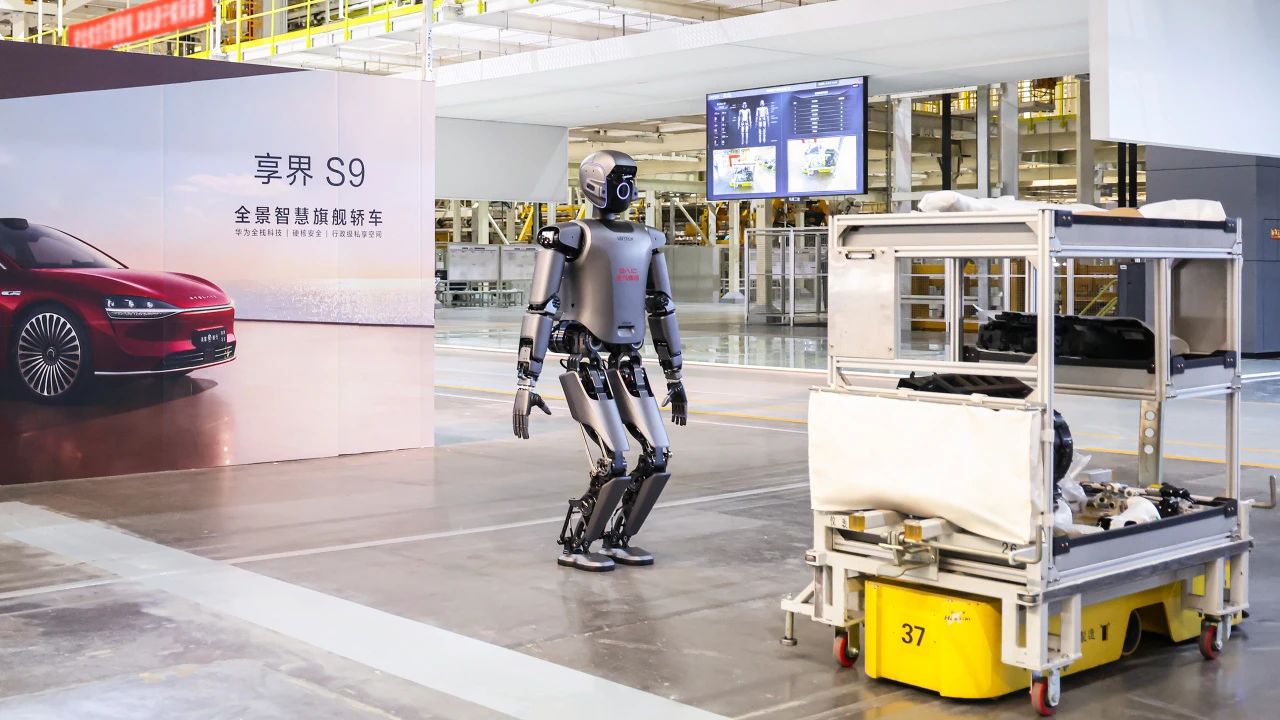
The image is arresting: a humanoid robot, bipedal and eerily proportionate, working shoulder-to-shoulder with assembly-line staff at a Chinese electric-vehicle plant. When BAIC BJEV confirmed it had partnered with UBITECH to integrate humanoid robots into new-energy-vehicle production, the announcement drew the usual split reaction — genuine fascination on one side, weary suspicion that this is theatre dressed up as technology on the other.
It is a fair question to ask. Automakers have spent a decade promising that robots would transform the factory floor, and much of what has been delivered is less revolution than repackaging. Yet dismissing BAIC BJEV's move as a stunt misreads both the company's trajectory and the particular moment it occupies.
A Company That Cannot Afford Distraction
Consider the context. Within roughly a year, BAIC BJEV has reported June sales of 30,282 units, up 152.54 percent, and full-year 2025 sales exceeding 200,000 vehicles, with its premium Arcfox brand surging and an 8.15-billion-yuan capital injection shoring up its balance sheet.
This is not a company with the luxury of idle experimentation. It is a manufacturer scaling hard, cutting costs where it can, and under real pressure to convert volume into margin. That pressure is precisely what makes the humanoid-robot question interesting. A gimmick is something you deploy when you can afford distraction. BAIC BJEV cannot.
Layered Onto an Already Automated Line
The more revealing signal is the depth of its automation partnership with ABB, whose systems underpin BJEV's newest EV manufacturing facility. Humanoid robots are not arriving into a vacuum of manual labour; they are being layered onto an already heavily automated line.
That distinction matters enormously. The genuine manufacturing shift in the industry is not the arrival of a walking robot — it is the arrival of flexible automation. Traditional industrial arms are magnificent at repetition and useless at variance. A humanoid form factor, if it works, promises something different: a machine that can be redeployed across tasks without a full line redesign, absorbing the small, awkward, variable jobs that have stubbornly resisted automation. That is the real thesis behind UBITECH's involvement, and it is a thesis worth taking seriously.
A Pilot, Not a Finished Strategy
Scepticism remains warranted. Humanoid dexterity, battery endurance, and cost-per-unit-versus-output are all unresolved, and no automaker has yet demonstrated humanoid labour at a scale that moves a production metric.
The honest read is that BAIC BJEV is running a genuine pilot, not a finished strategy — a distinction the company has been careful not to overstate. The press release is a signal of intent, not proof of delivery. But intent, in this industry, is not nothing.
Two Halves of the Same Wager
Zoom out, and the humanoid experiment sits inside a broader pattern. BAIC BJEV's deepening Pony.ai partnership — now branded "Cooperation 2.0" — is aimed at scaling L4 robotaxi production, while the company simultaneously trims capacity at its EV subsidiary, a move that reads as discipline rather than retreat.
Add humanoid robots to that picture and a coherent logic emerges: BAIC BJEV is betting that the next competitive advantage lies not in building more cars, but in building them with radically lower marginal cost and higher flexibility. The robotaxi push attacks the revenue side; the automation push attacks the cost side. They are two halves of the same wager.
So: gimmick or genuine shift? The truthful answer is that it is a genuine attempt at a shift, with the outcome still unwritten. What separates BAIC BJEV from the automakers who have made similar noises is that its moves are mutually reinforcing — capital, volume, autonomy partnerships, and factory automation all pointing the same direction. If the humanoid pilot fails, the company will have lost relatively little. If it succeeds, it will have quietly solved a problem the entire industry is circling. Either way, this is not a stunt. It is a wager, placed by a company that increasingly looks like it knows exactly what it is doing.