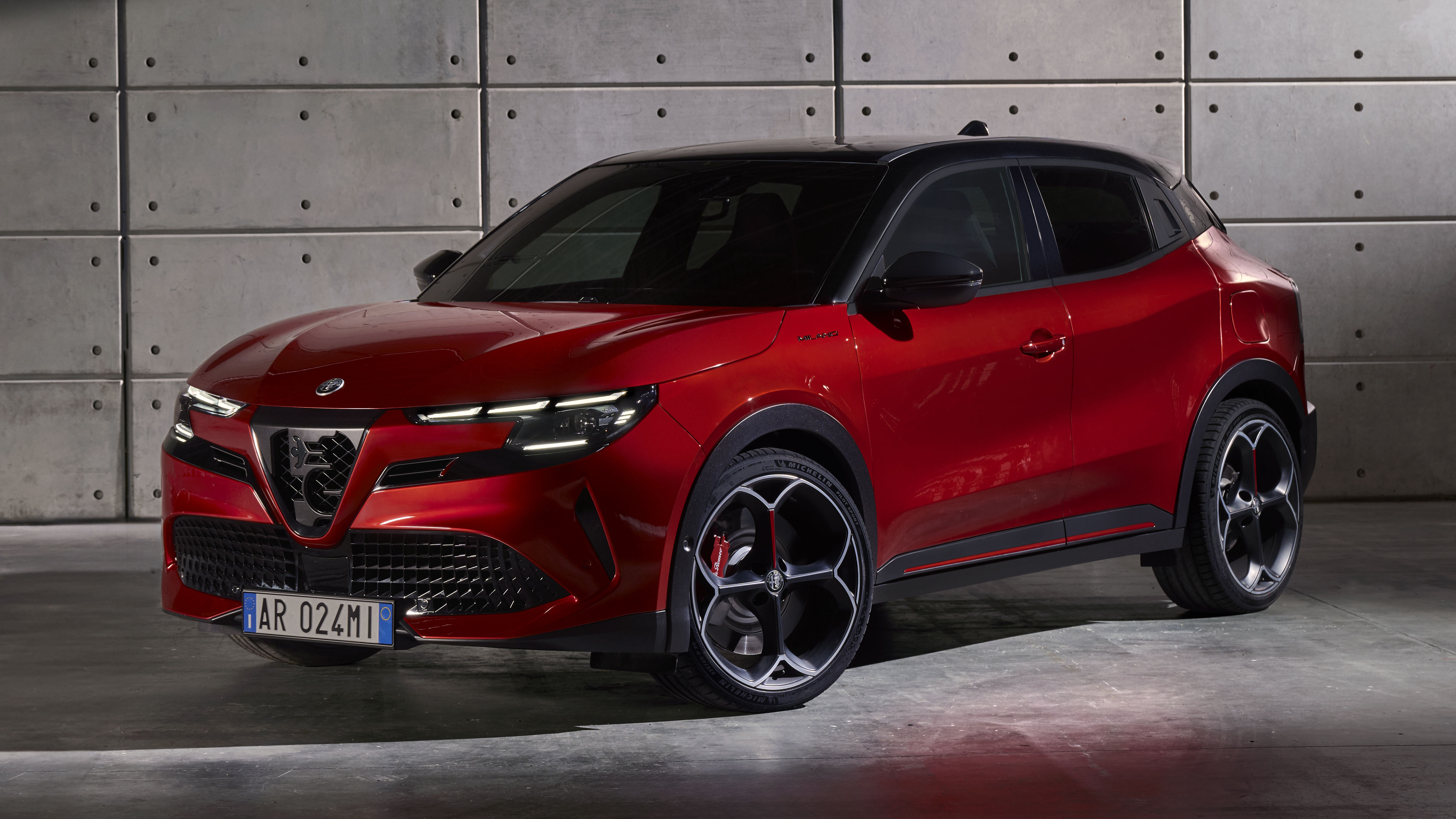
Alfa Romeo has spent the better part of a decade searching for its own reflection. The Giulia and Stelvio proved the engineering was never the problem — the Giorgio platform was a triumph, the Quadrifoglio badge as potent as ever. What the brand lacked was a clear articulation of where it was going, and at what altitude it intended to travel.
The Cuorerosso concept, unveiled in Paris, answers that question with a flourish that only Alfa Romeo could deliver. And the detail that tells us the most about where the marque is heading isn't the hybrid V6 or the electrified architecture. It's the doors.
A Confession in Sheet Metal
Rear-hinged doors are not a styling gimmick. They are an engineering confession. To hang a door from its trailing edge — coach doors, in the old parlance — you must commit to structural rigidity that conventional apertures simply don't demand. You must reinforce the B-pillar area, rethink the sill geometry, and accept the weight and cost penalties that follow.
Manufacturers do not make this commitment for a two-seat sports car, where the doors are short and the cabin is narrow. They make it for a car with a genuinely usable rear compartment — one that passengers are expected to enter with dignity rather than contortion. The Cuorerosso is being positioned, unmistakably, as a four-seat grand tourer.
The GT Returns to Its Homeland
This matters because Alfa Romeo has not built a proper four-seat GT since the Brera era, and arguably not a truly convincing one since the 105-series Giulia Sprint GT of the 1960s — the car whose sloping fastback and delicate proportions still define what an Alfa coupe ought to look like.
The market has spent those intervening decades migrating toward crossovers and SUVs, and Alfa has followed, with the Tonale and the forthcoming larger utility vehicle that may yet reach American shores. But a brand cannot survive on utility alone, particularly one whose entire mythology rests on the idea that driving is an emotional act rather than a logistical one. The Cuorerosso is Alfa Romeo's argument that the GT — the long-legged, four-place, beautiful machine that made the marque famous — still has a place in a lineup otherwise consumed by the practical.
Reading the Timing
The timing is telling. Alfa Romeo has reportedly paused development of the next-generation Giulia and Stelvio, a decision its CEO has framed as a recalibration rather than a retreat. Reading between the lines, the company appears to be reallocating resources toward a flagship that can carry the brand's identity in a way that another mid-size sedan simply cannot.
A four-seat GT with rear-hinged doors, a hybrid V6, and the kind of proportions that make photographers reach for their cameras is precisely the sort of halo product that justifies a brand's existence in an era of homogenized electric crossovers.
It is also, notably, the sort of car Ferrari once built — the 456, the 612 Scaglietti — before it retreated into mid-engined exclusivity. That territory is now vacant, and Alfa Romeo has noticed.
The Risk and the Reward
There is risk, of course. Rear-hinged doors invite comparisons to the Mazda RX-8, a car whose Freestyle door arrangement was clever but never quite elegant, and to the Rolls-Royce Phantom, whose coach doors carry a different sort of cultural weight entirely.
Alfa Romeo will need to execute the mechanism with a precision that feels engineered rather than theatrical — the doors should open with the same mechanical honesty as a well-weighted steering rack, not the ponderous ceremony of a luxury barge. But the mere fact that the company is willing to attempt it suggests a confidence that has been absent from the brand's recent product planning. The Cuorerosso is not a cautious car. It is a declaration.
What Alfa Romeo has done with this concept is remind the industry that design leadership is not a matter of screen size or battery range. It is a matter of proportion, gesture, and the willingness to build something that exists for reasons beyond the quarterly earnings call. The rear-hinged doors are the clearest signal yet that the Cuorerosso is not merely a styling exercise but a statement of intent: Alfa Romeo intends to build grand tourers again, and it intends to build them properly.